

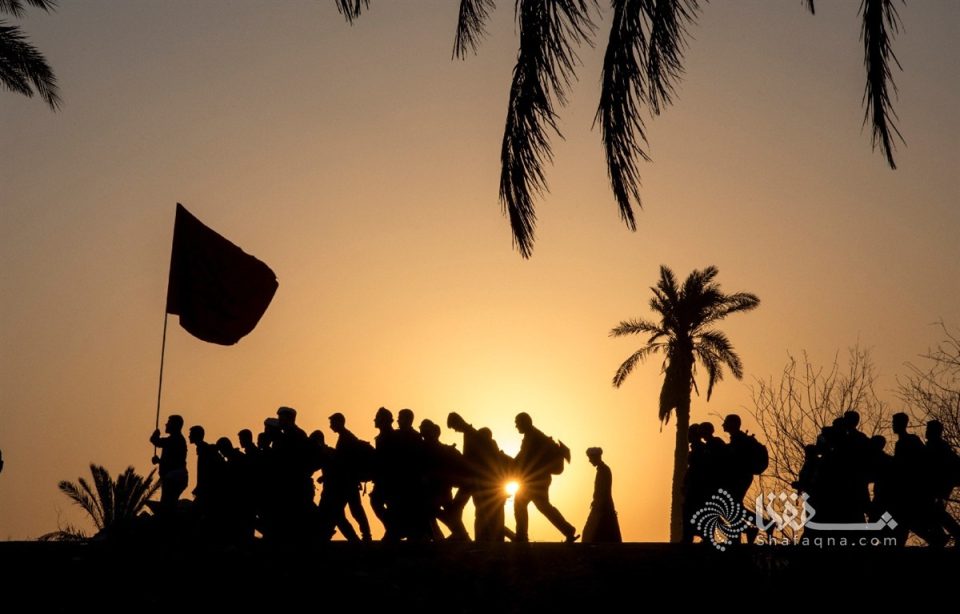
Shafaqna English– The Tourism Management Perspectives has published the paper: “A Phenomenological Study of Arbaeen Foot Pilgrimage in Iraq” written by Umme-Salma Mujtaba Husein in 2018. This paper analyzes motivations and experiences of foot-pilgrims in their journey to Karbala (Iraq) during the Arbaeen pilgrimage.
According to Shafaqna, in contemporary literature, religious pilgrimage is considered as a subcategory of modern pilgrimage that involves a religiously motivated travel to a sacred place that could contain: a) elements of the natural environment such as mountains, rivers, caves, groves or even animals; b) religious sites such as churches, temples, or shrines; c) venue for religious activities, rituals, or festivals.
Pilgrimage structure encompasses how a pilgrimage is performed. Walking to the sacred place that is performing the pilgrimage on foot, falls in the premise of a pilgrimage’s structure, since it indicates how the pilgrimage is performed. In order to realize foot pilgrimages, specific routes are developed for pilgrims to begin the physical journey.
The motivation and experiences, motivations for repeat or revisit behavior and the findings are mentioned below:
- What matters on a pilgrimage is the experience itself. The foot pilgrim being the central character of the pilgrimage story has specific motivations when undertaking pilgrimage. It is the foot pilgrim’s contemplations, motivations and experience that exactly define the significance of the journey.
- The intentions of repeat pilgrims are noted as to ‘renew their feelings’, ‘to meet friends once again’, ‘to continue the path of self-discovery’, ‘to revise how the first pilgrimage was made’, and also to prevent the present of their daily lives.
- The Shia Muslims belief in the distinct sacredness of the imams has generated the practices of visiting and revering the places where the imams are buried, resulting in the emphasis on shrine pilgrimage (termed as ‘Ziyarah’) more than the Sunnis Muslims.
- Visiting the shrine of Imam Hussain (AS) in Karbala carries unusual virtues. It is narrated from Imam Sadiq (AS), “Allah (SWT) will erase the sins of those who perform the Ziyarah of Hussain (AS) with the intention of gaining the pleasure of Allah (SWT). They will be sinless like a new born baby. Angels will accompany them on their way to Ziyarah. The angels will spread their wings over them until they return to their families.” (Bin Quluya Al-Qummi, Chapter 5, Hadith 5).
- Foot-pilgrims were motivated by continuous religious acts associated with the historical event of Karbala. Actually, this is a deep addition to the current contemporary literature wherein pilgrim’s motivations are interwoven between sacred and secular; motivations of Arbaeen foot-pilgrims are centered on sacramental intentions associated with religious acts. This displays the power of sacraments and society in Shia religious perspective, the distinct aspect being the absence of touristic motivations of enthused by curiosity or pleasure-seeking.
- The reoccurrence of ‘concern for society (Ummah) as a motivation for all foot-pilgrims regardless of the number of times they were enroute is consistent with Islamic teachings of social responsibility. The force of social responsibility plays the central role, where fascinatingly, foot-pilgrims introduce the practice to family members and larger society by means of various platforms of social media, which thereafter bring in sustainability and growth to the ‘Meshaya’ practice.
- Another motivational element centers on ‘enhanced love for the Imam (AS)’, and this actually is an insightful finding that shows the similarity with the Victorian era wherein pilgrimage was full of emotion. On the contrary, the postmodern accounts of pilgrimage studies sparsely mention the function of emotions and where ‘love’ is mentioned, it is noted as a distinguished emotion occurring in connection to God’s Love.
- The ‘Meshaya’ experience, converges on religiosity elements, signaling to the sacredness of the journey as opposed to the popular construction of other walking pilgrimages, in which foot-pilgrims draw parallels with five out of six types of pilgrims identified by Morinis (1992) subtracting the first one; “devotional” (p. 10). This deliberation is established for the reason that whilst thinking bodily experiences, foot-pilgrims yet have a tendency to relate it to religious spirituality by adopting expressions such as ‘pain with different flavor’ and ‘hardships but with love of the Imam’. Furthermore, the hospitality experiences are also related to ‘manifestation of Islamic hospitality’.
- The ‘Meshaya’ practice has a spiritual uplifting effect; Turner (1973) perceives pilgrimages as a means to venturing into religious experience through use of the physical body. Hence, the bodily experiences essentially offer rich and out of the ordinary experiences to further precipitate the spiritual status meant to be realized in the life journey of a believer as a traveler (salik), essentially this is established from the Islamic worldview (Mujtaba, 2016).
- The dominant reason pointed out by pilgrims walking to the shrine of Imam Hussain (AS) in Karbala was ‘a burning desire’ to perform the Ziyarah (pilgrimage). This major stimulus expressed by first time foot-pilgrims, can be separated in two categories, i.e., Religious act-led desire and Society-led desire. Accounts of rituals-led desire indicate factors such as commemorations held each year at pilgrim’s residence countries, in which scholars narrate the tragedy of Karbala. Pilgrims specifically indicated they made an intention (Niyyah) during the practices at home to walk the way, and felt the foot-pilgrimage was their yearnings fulfilled. ‘Always wanted to walk to my Imam’, was a common comment by many foot pilgrims.
- Foot-pilgrims expounded that they attended mourning commemorations and another element was the ‘technology aspect’, where foot-pilgrims narrated how watching the Arbaeen rituals on different media either live or watching documentaries/pictures/movies and reading stories in written format or posted as Instagram stories, watching friend’s stories on snapchat and videos posted by caravans, resulted in the intention to walk.
- Foot pilgrims were motivated by the historical Karbala incident and the sacred figure of Imam Hussain (AS) acted as the magnet towards, both the shrine, and the journey towards it. This is quite linked to the Prophet of Islam’s (PBUH) narration: ‘Indeed, the martyrdom of Imam Hussain (AS) does create such a fire, a burning sensation and heat of a love in the hearts of his believers and loving friends which will never get cold or extinguished’.
- The other significant category that surfaced was those who began walking, led by the societal elements; they were inspired, enthused or led by a confrère throughout the trip.
- Society-led desire shows the similarity with Turner’s (1974) communitas, indicating a social element to a spiritual experience and a spiritual element to a social experience. A sense of communitas prevails in the foot-pilgrims that transcend their diverse backgrounds owing to the sense of shared devotion. The interesting aspect that rightly adds to Turner’s communitas is the fact that the sense of ‘Ummah’ formerly exists among the pilgrims, and as such the need to liberate from social identities from conformity (structure) to general norms is not a necessity to experience the enhanced social bond that, according to Turner’s belief is the product of pilgrimage experience.
- Pilgrims who undertook the journey on foot the second-time round, explained that their stimuli centered on a) Love and devotion for Imam Hussain (AS) and b) Concern for society. Participants whose sentiments were built around ‘love of the Imam (AS)’, mentioned their affection and feelings for the Imam and his family had further intensified following their first ‘Meshaya’ experience. Repeat foot-pilgrims also explicated to draw attention of family and other members of society towards the ‘Meshaya’ practice, this concern of umma shall be a catalyst for sustainability and growth in Arbaeen foot pilgrims, as younger generations continue arriving. The practice of ‘Meshaya’ is also seen as an ostentatiousness of unification, which is exactly analogous to the annual obligatory hajj that is an expression of unity, equality, and solidarity regardless of nationality, ethnic origin, sex, and social class.
- Foot-pilgrim’s experiences could be grouped into three categories: Religiosity experiences, Bodily experiences and, Humanitarian and Hospitality experiences. Religiosity category captures accounts of foot-pilgrim’s feelings associated with reliving Islamic teachings, closeness felt to the Prophet’s (PBUH) household and Imam Hussain (AS) in particular and supernatural occurrences. Bodily experiences relate to the variety of views on the physical walk endeavor. Humanitarian experiences implied sentiments associated with generosity and friendliness occurrences during the ‘Meshaya’.
- The martyrdom of Imam Hussain (AS) and his forces at Karbala was an important milestone in Islamic history and in the Shia community; this has generated the demonstration of grief and passion. Nakash (1993) elucidates the rituals developed since the Battle of Karbala where recitation of Karbala narratives (Qira’ah) by a reciter (Qari or Khateeb), and Niyahah (recitation of rhythmic lamentation poetry) are performed. The foot-pilgrimage manifests the rituals experience in the real settings and this is meant to increase the rewards of the pilgrims, as it is believed that even a tear shed in the memory of the sufferings of an imam will lead to him exercising his intercessory powers (Ayoub, 1978:143).
- Foot-pilgrims used variety of expressions to explain the ‘humanitarian experiences’ experienced during the walk. The phrases were; ‘kindness, selflessness, generosity, bravery, self-sacrificing, humanity at its peak, compassion, warmth, unity, inspiring hospitality, simplicity, humility, enthusiasm, love and sheer devotion’.
- The prominence of Iraqi hospitality during the walk experience demonstrates the distinctive aspect of Islamic hospitality as exemplified in the manner in which Prophet Abraham (AS) treated his guests (the Quran 24:27). The warmth and generosity on the way to Karbala offers insights to the local Iraqi food and culture to pilgrims. All food variety served on the walk trail are Iraqi delicacies that range from special tea to fish served on bed of rice with beans, and variety of sweets. Although the Iraqi hospitality towards pilgrims is on a colossal scale, however similar practices are narrated on hospitality enroute Czestochowa.
- Although role of rituals is found to have some part in building interpersonal trust and feelings and confirming one’s place in a community, it’s role in initiating the thought process for undertaking the foot-pilgrimage is a novel finding for pilgrimage literature.
Source: sciencedirect