

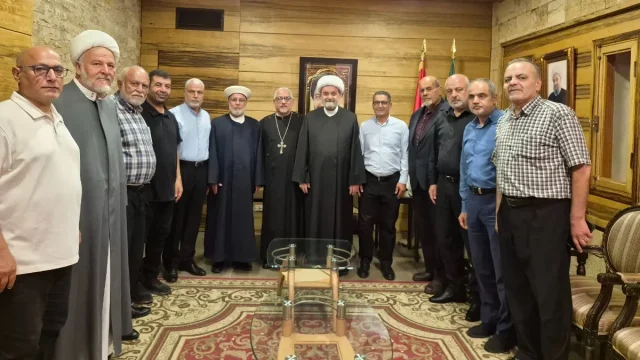
SHAFAQNA ENGLISH– Sheikh Hassan Abdullah, the Mufti of Tyre and the Jabal Amel region, said: “The thought of Imam Sayyed Musa al-Sadr was not a project for a particular sect or group. Rather, it was a national, humanitarian, and comprehensive vision based on protecting Lebanon, preserving its unity, and strengthening coexistence.
According to Shafaqna, Sheikh Abdullah stressed that the strength of a country lies in its ability to accommodate differences and accept the other, rather than seeking to eliminate or marginalize them.
Speaking during a meeting with a delegation from the administrative board of the “Imam Sadr Cultural Forum,” headed by Dr. Abbas Haidar, at the Ja’fari Dar al-Ifta in Tyre, he added: “Imam Sadr was a pioneer of a progressive vision of coexistence in Lebanon—a vision based on respecting and accepting the other, regardless of the extent of differences. He believed that Lebanon’s diversity, if managed through dialogue and responsibility, could become a source of strength rather than a cause of division and estrangement.”
During the meeting, which focused on Imam Sadr’s thought, his national positions, and his role in Lebanon and the Arab and Islamic worlds, Sheikh Abdullah highlighted the role Imam Sadr played in protecting Lebanon. He noted that Imam Sadr’s positions and his calls for resistance and the defense of the homeland were not, in his view, separate from his vision for building the state and society. Rather, they formed part of a comprehensive and integrated project aimed at preserving human dignity and safeguarding Lebanon’s sovereignty and unity.
He pointed out that revisiting Imam Sadr’s thought today should not be limited merely to recalling historical periods. Rather, it is a cultural and national responsibility that requires his principles and foundations to be applied practically in public life, particularly in addressing divisions and disputes and strengthening the language of dialogue and rapprochement.
Those attending the meeting emphasized the importance of keeping Imam Sadr’s thought alive in the cultural and national spheres—a thought centered on the human being, dialogue, unity, and coexistence, and one that places Lebanon’s interests above narrow group-based calculations and considerations.