

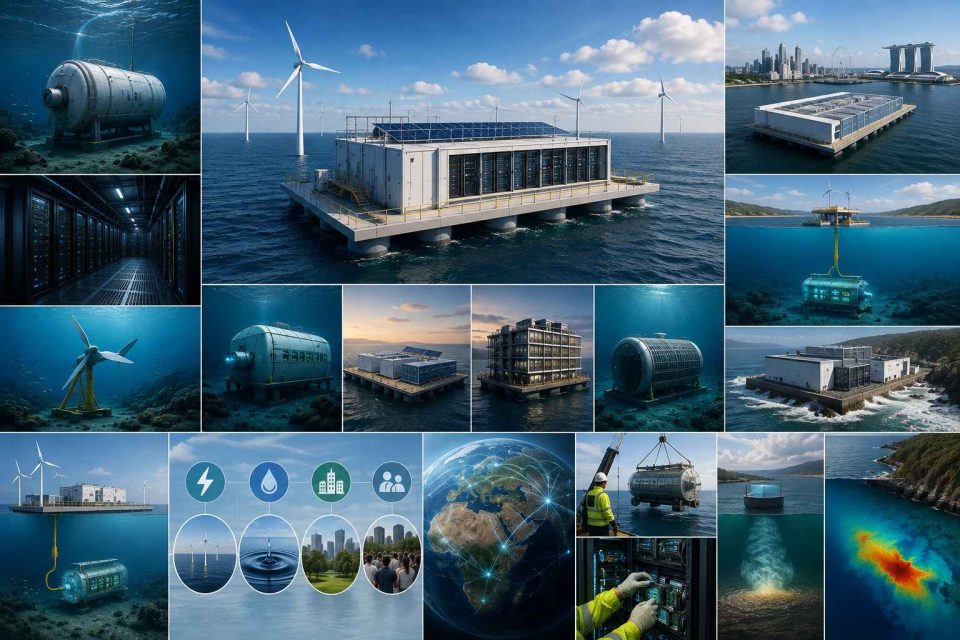
Shafaqna English- The rapid expansion of artificial intelligence is pushing companies to explore underwater and floating data centers as potential alternatives to land-based facilities, with the aim of reducing pressure on electricity, freshwater and land resources, according to The Conversation.
AI data centers require large amounts of energy and cooling, increasing concerns over their environmental footprint. Developers are investigating whether seawater cooling and offshore renewable energy could make ocean-based facilities more efficient.
Microsoft was an early pioneer, testing an underwater data center near Scotland’s Orkney Islands in 2018. The 864-server facility recorded server failure rates about eight times lower than comparable land-based systems during a two-year trial. Microsoft ended the project in 2024, however, and returned its focus to land-based facilities, which are easier to expand, repair and upgrade.
Other countries are continuing to experiment with ocean-based infrastructure. China launched a wind-powered underwater data center in Shanghai in 2025 and began commercial operations in 2026. The facility uses seawater for cooling and reportedly consumes at least 30% less electricity than conventional data centers.
Japan is testing container-based data centers on floating platforms, powered by solar energy, while Singapore’s Keppel is developing a floating four-story data center scheduled to open in 2028. South Korea is also planning an underwater facility in Ulsan that could accommodate more than 100,000 servers.
Similar projects are being proposed elsewhere, including a tidal-powered submersible data center in Maine and a land-based facility in Portugal that uses seawater to cool its servers.
Ocean-based facilities could reduce demand for freshwater and grid electricity while avoiding competition for scarce urban land. Their offshore locations could also reduce opposition from communities concerned about the expansion of large data centers.
However, maintenance remains a major obstacle. Equipment failures underwater cannot easily be repaired on site, potentially requiring entire sealed modules to be brought to the surface.
Environmental concerns are also significant. Returning heated seawater to the ocean could affect local oxygen levels, pH and marine ecosystems. Existing facilities in China and Portugal have reported seawater temperature increases of less than 1C, but researchers warn that widespread deployment could create localized thermal pollution.
With marine ecosystems already facing warming and degradation, the sustainability of underwater computing remains uncertain. Ocean-based data centers could help reduce AI’s pressure on land, energy and freshwater—but only if their environmental and technical costs can be effectively controlled.
Source: The Conversation