

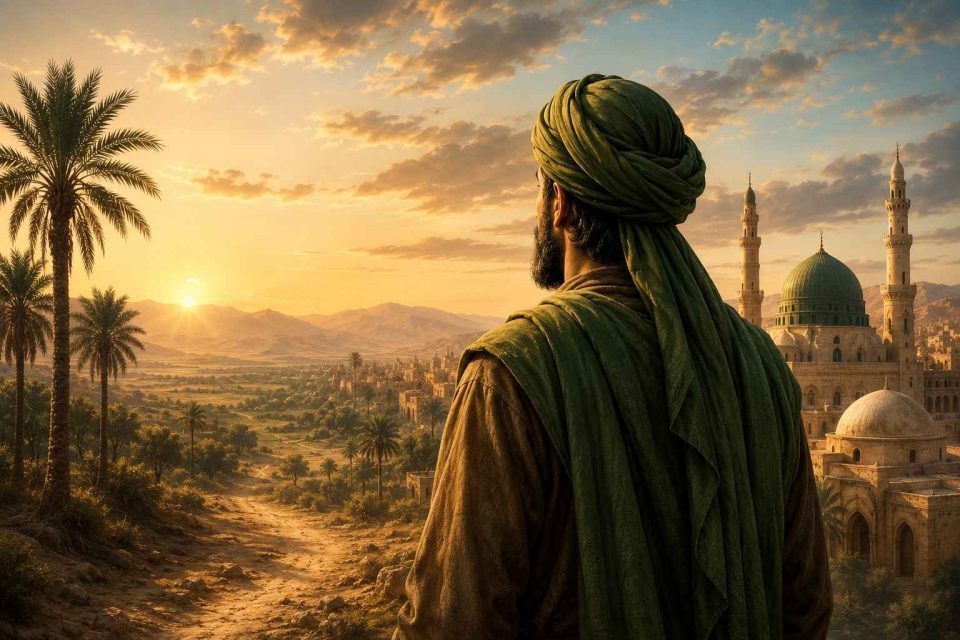
Shafaqna English– Salman al-Farsi, a renowned Companion of the Prophet Muhammad (PBUH and his family) and one of the companions of Imam Ali (AS), held a distinguished position among the Companions. The Prophet regarded him as one of his Ahl al-Bayt (the People of the Household). He is also regarded as one of the Four Pillars of Shiism. Salman was said to possess knowledge of the Greatest Name of God (Ism al-A‘zam), and his spiritual rank was considered higher than that of Luqman the Wise.
According to Shia traditions, Salman, who was known to be from Isfahan, never prostrated before anyone other than God. He possessed a profound spirit of truth-seeking and traveled across different lands in pursuit of truth. He studied the purification and cultivation of the soul under Christian bishops until he was given glad tidings of the coming of the last Prophet in the land of Arabia. Salman then traveled to the Hijaz in search of the Prophet, and upon witnessing the signs of prophethood in him, he embraced faith.
The Story of Salman’s Conversion to Islam
In its earliest manifestation, Christianity shone upon Salman’s heart like a fleeting ray of faith.
One day, Salman was sent by his father, a Zoroastrian fire-worshipper, to inspect the family’s fields. On his way, he came upon a place of worship where a group of people were engaged in prayer and devotion. Salman’s inquisitive and questioning spirit led him to seek the truth behind this unfamiliar faith. He questioned its followers about their religion and expressed his interest in it. Guided by them, he eventually embraced the faith and adopted Christianity.
One day, Salman set out with a caravan for Syria (al-Sham), which was at that time the center of Christianity. There, he spent seven years serving in a church. He later traveled to Mosul, where he stayed with a monk, and then journeyed to the city of Amuria. From there, he joined a caravan bound for the Hijaz in search of the Prophet of Islam. However, the people of the caravan sold him to a Jew, who in turn sold Salman to a woman named Khalisa in Yathrib. Salman worked in the woman’s fields and date-palm orchards in Yathrib. It was there that he learned that the Prophet of Islam (PBUH and his family) had been commissioned with his prophetic mission in Mecca. Yet Salman was unable to meet him until the Prophet (PBUH and his family) arrived in Medina.
Salman already knew that the prophet would arise in that land and that he would bear certain signs: he would not accept charity (sadaqah), but he would accept gifts, and the seal of prophethood would be imprinted between his shoulders. Thus, when Salman encountered the Prophet (PBUH and his family) in the region of Quba, he brought him some dates as charity. He saw the Prophet instruct his Companions to eat from them, while he himself did not partake, because they had been given as charity.
Then, one day in Medina, Salman saw the Prophet (PBUH and his family) and presented him with some dates as a gift. The Prophet ate from them. To witness the third sign, Salman waited until another day, when the Prophet had gone to Baqi‘ al-Gharqad to attend the funeral of one of his Companions. Salman stood behind him, and when the Prophet’s garment shifted, he saw the seal of prophethood upon his back. Salman threw himself upon it, kissed it, and wept. He then embraced Islam and related his entire story to the Noble Messenger of God (PBUH and his family).
Salman in the Era of the Noble Prophet (PBUH)
The enduring place of Salman’s name in history is closely associated with his presence at the Battle of the Trench. When the Khuzāʿah horsemen, who were four days away from Mecca, brought word to the Prophet (PBUH and his family) that Quraysh and a vast Arab army were on the move, and when the Muslims learned of the treachery of the Jews, a cloud of fear descended upon Medina.
The Prophet (PBUH and his family) immediately summoned his Companions to consult with them. Some proposed that they leave Medina and confront the enemy wherever they encountered them, taking up their swords in battle. Suddenly, Salman al-Farsi stepped forward and presented his historic proposal: following the Persian practice of warfare, a trench should be dug around the city. The Prophet (PBUH and his family) accepted his proposal.
According to a well-known narration from the Prophet (PBUH), while the Muslims were digging the trench for the Battle of the Trench, Salman recited several verses of poetry expressing his loyalty to the Prophet. Thereafter, each tribe claimed Salman as one of its own. It was then that the Prophet uttered his famous words:
“Salman is one of us, the People of the Household.”
Thus, the Prophet counted Salman among his Ahl al-Bayt.
Salman was also the first person to translate the Qur’an into Persian. He served the Prophet (PBUH and his family) as an interpreter between the Persian and Arabic languages.
The Exalted Rank of Salman in the Eyes of the Prophet (PBUH)
All Muslims, including the Sunnis, acknowledge Salman al-Farsi’s exalted status. Yet, in the Shia tradition, apart from the Infallible Imams (peace be upon them), Salman al-Farsi is regarded as the greatest and most revered of the Companions of the Prophet of Islam (PBUH and his family). He attained the highest degrees of faith and perfection, earning the distinction of being described by the Messenger of God as:
“Salman is one of our Ahl al-Bayt.”
The renowned mystic Muhyiddin Ibn Arabi, despite being a Sunni scholar, explains this statement of the Noble Prophet (PBUH) by saying that Salman’s inclusion among the Ahl al-Bayt (AS) signifies the Messenger of God’s testimony to Salman’s exalted rank, purity, and soundness of soul. The Prophet’s (PBUH) designation of Salman as one of the Ahl al-Bayt (AS) does not refer to a blood relationship; rather, it reflects his possession of the highest human virtues.
According to a narration from the Prophet (PBUH and his family), Paradise longs for three people: Ali (AS), Ammar, and Salman. In another narration, Salman is counted among the four people for whom Paradise yearns.
Salman has been regarded as one of the best, most ascetic, most knowledgeable, and closest of the Companions of the Prophet (PBUH and his family).
Another saying attributed to the Prophet (PBUH) regarding Salman states:
“Salman is a sea that never runs dry and a treasure that never comes to an end.”
According to another narration from the Prophet (PBUH), whoever harms Salman has harmed the Prophet (PBUH) himself.
Salman was also among those who, together with Abu Dharr, Ammar, and Miqdad, went—at the invitation of Imam Ali (AS) and upon his recommendation—to visit Lady Fatima al-Zahra (SA). Lady Fatima (SA) said to Salman:
“Three exceedingly beautiful women came to me one evening after the death of my father, the Messenger of God. They told me that they were women of Paradise. One was named Dhurrah, destined for Abu Dharr; another was Maqdudah, destined for Miqdad; and the third was Salma, destined for Salman. They said that God had created their counterparts for Abu Dharr, Miqdad, and Salman.”
After the event of Saqifah and the martyrdom of Lady Fatima (peace be upon her), Salman took part in her secret burial, a testament to his exceptional position and closeness among the Ahl al-Bayt (peace be upon them).
Jaber narrates that the Messenger of God (PBUH) said:
“Indeed, Paradise longs for Salman more than Salman longs for Paradise; and Paradise yearns more eagerly to meet Salman than Salman yearns to meet Paradise.”
The Noble Prophet (PBUH) also described Salman in these words:
“Whoever wishes to look upon a man whose heart God has illuminated with faith, let him look upon Salman.”
He also said:
“Salman is from me. Whoever wrongs him has wronged me, and whoever causes him distress has caused me distress.”
Salman’s Knowledge
The Prophet of Islam (PBUH) said:
“If religion were in the Pleiades, Salman would reach it.”
The breadth and depth of Salman’s knowledge were so immense that they are beyond the comprehension of most people. Imam al-Sadiq (AS) said that the Messenger of God (PBUH) and Imam Ali (AS) would entrust Salman with secrets that others did not have the capacity to bear, considering him worthy of safeguarding hidden knowledge and profound mysteries. For this reason, one of Salman’s titles was “Muhaddith”—one who receives and conveys sacred knowledge.
Salman possessed knowledge of balāyā wa-manāyā—knowledge of future trials, events, and destinies—and was also regarded as an expert in physiognomy and among the Muhaddithūn, those endowed with spiritual knowledge and inspired insight. Salman’s scholarly standing was so exalted that Imam al-Sadiq (AS) said of him:
“In Islam, no man has been created who was more learned in jurisprudence than Salman.”
The Prophet of Islam (PBUH) also said:
“Salman is a sea of knowledge whose depths cannot be reached.”
Salman’s Role in the Spread of Shi‘ism among Iranians
One of Salman’s most important endeavors—an undertaking that occupied a major part of his life—was his persistent effort, after the passing of the Messenger of God (PBUH), to introduce people to pure Islam and authentic Shi‘ism. In pursuit of this mission, he struggled in Medina and seized every opportunity available to him. When he later came to Ctesiphon (Mada’in), he continued along the same path and played a significant role in the spread of Shi‘ism among the Iranians.
One may ask: Although Islam entered Iran during the caliphate of the second caliph, why is the overwhelming majority of Iranians Shia and followers of Imam Ali (AS)?
The answer lies in a number of factors. One of the earliest and most important was Salman’s presence in Mada’in, as well as his journeys to Kufa and its surrounding regions, and even to Isfahan and other areas. Salman was a herald of pure Islam, a preacher of Shi‘ism, and a bearer of the message and promise of the school of the Ahl al-Bayt (peace be upon them). The majority of Iranians heard this call and this promise—and embraced it.
Source: Wikishia, Wikifeqh, Beytoote
- Read more from Shafaqna: Jabir ibn Abdullah al-Ansari: A life of faith, knowledge, and devotion to Prophet (PBUH)