

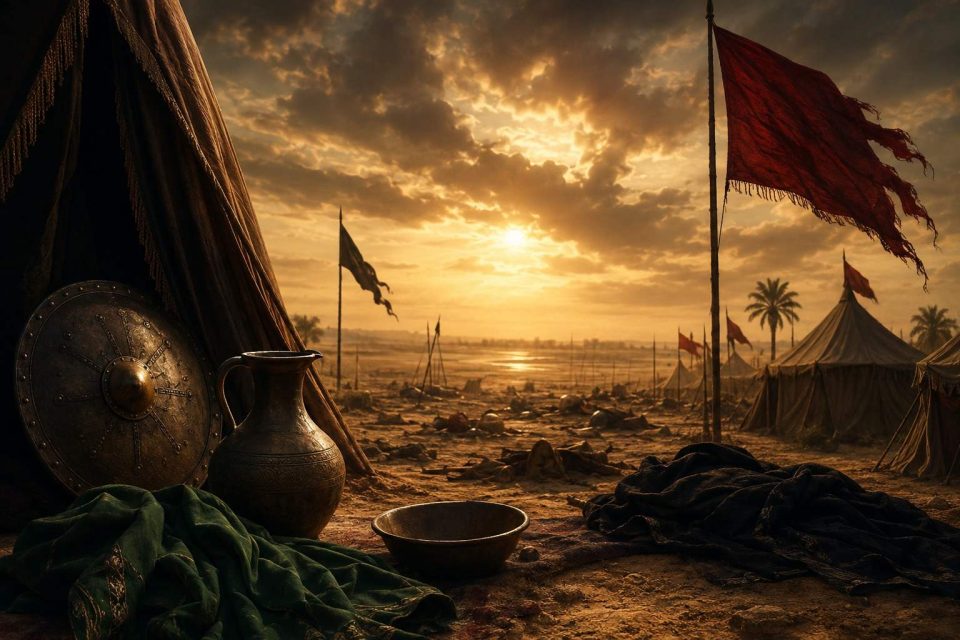
English Shafaqna- In the year 61 AH, in a land called Karbala, near the Euphrates River, an event took place unlike anything history had witnessed until then. Contrary to the familiar assumptions of society, the tragedy of Karbala was not solely an epic and spiritual movement of men; rather, the role of women in this path is so evident that one can say with certainty: had it not been for the selflessness of women, the blood of Imam Hussain (AS) would never have flowed into its rightful course — the course that laid the foundation of a revolution and led to immortality.
Who were the heroic women of Ashura?
Although many of the women closest to Imam Hussain (AS)—such as Lady Zaynab (SA), his wife Lady Rubab, and his daughters Umm Kulthum and Fatimah—played as pivotal a role on the battlefield of Karbala as the men (especially before the epic), and had their names inscribed in the history of Islam as architects of the Ashura uprising, there were also many lesser-known women during that era. Each of them, in their own profound way, played a significant role in advancing and ensuring the immortality of this monumental epic.
Mariyah, Daughter of Sad
The house that became a station of invitation and a point of departure toward Imam Hussain (AS) belonged to a woman from the Abd al-Qays tribe in Basra, named Mariyah. She advanced in the very path of the mission once undertaken by Khadijah, who devoted her wealth in the service of Islam.
During the course of the Ashura uprising, Mariyah placed her home at the disposal of Imam Hussain (AS) and the lovers of the Ahl al-Bayt (AS). It was from her house that the letters Imam Hussain (AS) had sent to the leaders of Basra were dispatched to them, calling them to support him and reminding them of the duty of obedience. The Shia would gather in her house, remain informed of the political events and news of the day, and those who answered Imam Hussain’s (AS) call would assemble there before setting out from that very place.
Ṭawah and the Sanctuary of the Imam’s Envoy in Kufa
The protagonist of this courageous chapter is a woman of profound faith and resolve named Ṭawah. Driven by her love and unwavering devotion to the Household of the Prophet (PBUH), she acted when the faithless men of Kufa—having once pledged their allegiance to Muslim ibn Aqīl—broke their vows and abandoned him in their desperate fear for their own lives.
Muslim ibn Aqīl, left wandering, estranged, and solitary in the streets of Kufa, sought only a way to convey the news of Kufas treachery to Imam Hussain (AS). He found himself without shelter, a target pursued by the agents of Ibn Ziyad. It was in this hour of abandonment that Ṭawah learned of his identity. Forsaking all fear for her own life, she offered him sanctuary. Through this act, she fulfilled the sacred right of the Imam and his envoy, and thus, the tale of her chivalry, courage, and devotion to the Ahl al-Bayt (AS) remains immortalized in the annals of history.
The wife of Habib ibn Muzahir
Another woman worthy of reverence is the wife of Habib ibn Muzahir, who lovingly and willingly accompanied her husband in his resolve and bade him farewell on the path of jihad alongside the Imam. Habib had been collecting pledges of allegiance for Imam Hussain (AS) in Kufa. When Ibn Ziyad tightened his grip upon the people of Kufa, he went into hiding among his tribe, waiting for an opportunity to join the Imam’s caravan. After the departure from Medina, and following the arrival of letters from Imam Hussain (AS) sent letters to his companions, and one of these was addressed to Habib ibn Muzahir. When Habib’s wife saw the letter, she said to him: “For the sake of God, Habib, do not fall short in supporting Hussain and if you have the honor of meeting Hussain (AS), then kiss his hands and feet on my behalf.”
The Multifaceted Roles of Women in Karbala
In the tragedy of Karbala, women bore a multitude of profound and vital responsibilities. Yet, the paramount mission entrusted to them—most notably to Lady Zaynab (SA) and the noble household of Imam Hussain (AS)—was the preservation of memory: to recount the events of Karbala, to disseminate the Imam’s message to all, and to ensure that the spirit of this event would remain eternally vibrant in the consciousness of humanity.
While the duty of armed combat against the enemy was lifted from the shoulders of women, certain courageous souls present on the battlefield took up the fight themselves, inscribing their names into the annals of history forever through their defiant presence and heroic resilience.
The endeavor to prevent the martyrdom of Imam Hussain (AS)
Among the most sacred duties of women within the Ashura movement was the endeavor to prevent the martyrdom of Imam Hussain (AS). On the morning of Ashura, as Lady Zaynab (SA) witnessed Imam Hussain (AS) fallen upon the earth, surrounded by criminal enemies’ intent on his slaughter, she emerged from her tent and addressed Umar ibn Sad in rebuke: ‘O son of Sad! Shall Abu Abdillah be slain while you stand by and watch?!’ He offered no reply, turning his gaze away from the noble Lady Zaynab (SA).
The inspiration of spirit
Throughout the annals of warfare, the encouraging presence of women on the frontlines has often served to fortify the resolve of combatants. In the crucible of Karbala, the mothers and wives of the martyrs embodied this role, breathing courage into the hearts of those standing firm for justice.
The grace of caregiving
Attending to the wounded and tending to the sick is among the vital roles women fulfilled on the battlefield, a mission central to the events of Ashura. A profound example of this is found in the compassionate care and guardianship provided by Lady Zaynab (SA) to Imam Sajjad (AS).
Leadership in the heart of crisis
The emergence of dire and critical circumstances often unveils the true depth of an individual’s capacity for leadership. The role of Lady Zaynab (SA) in the Ashura movement, particularly in her stewardship of the caravan of captives, serves as an eternal lesson in “Crisis Management.” She guided the survivors in steadfast alignment with the movement’s sacred objectives, skillfully neutralizing every attempt by the enemy to diminish the impact of Ashura and thwarting their every stratagem.
The preservation of sacred values
Another enduring lesson bestowed by the heroic women of Karbala is the preservation of religious sanctity and the defiance against the desecration of the Prophet’s (PBUH) household. Despite their state of captivity, they remained resolute in upholding modesty and dignity in the face of lewd and voyeuristic gazes. In the streets of Kufa, Umm Kulthum cried out in righteous indignation: “Have you no shame, that you gather to gaze upon the household of the Prophet (PBUH)?” Even when detained within a house in Kufa, Lady Zaynab (SA) remained an unyielding guardian of sanctity, permitting none but women to enter her presence.