

Shafaqna English- Abolfazl Fateh and Hossein Entezami wrote jointly in an article on “national and Iranian journalism”:
The purpose of this inquiry is not to invent new principles for journalism in Iran or to create an identity for national and Iranian journalism. Rather, it is an invitation to understand our relationship with nearly two centuries of Iranian journalistic endeavor and to identify its key concerns and defining characteristics. Despite all its diversity and plurality, this endeavor—from Kaghaz-e Akhbar to the present—has demonstrated an attachment to two fundamental principles, “Iran” and “the people,” adherence to two norms, “literary and visual civility” and “spiritual respect,” and ultimately a historical function: “playing a role in bringing about change.” It is an endeavor that has been part of a continuing concern that today can be called “Iran as Told by Iran.”
According to Shafaqna, the full text of the article is as follows:
The Fifth part of “Iran as Told by Iran”; Another Reflection on “National Journalism and the Iranian Pursuit of Truth”
In the Name of God
In a previous article titled “National Journalism: An Introduction to the Iranian Pursuit of Truth,” we raised the question of whether journalism, alongside its universal principles and standards, can possess—or be influenced by—an identity arising from the history, culture, language, lived experience, and civilizational horizon of a nation.
Can we speak of “Iranian journalism” or an “Iranian journalism culture” in the same way that we speak of Iranian architecture, Iranian music, Iranian cinema, Iranian painting, and Iranian carpets?
This article attempts to examine, from a historical perspective, the possibility of such an identity and its potential characteristics in terms of methods, form, and content.
Form and Aesthetics: Visual Structure
First, the modern media era in Iran did not begin in a vacuum. Rather, it took shape through interaction with an existing communicative, written, and visual heritage.
As we know, Iranian society possessed its own distinctive written and communication traditions long before Kaghaz-e Akhbar.
Centuries before the emergence of newspapers, Iranians used various forms and methods to record, transmit, and disseminate messages—from Achaemenid inscriptions and stone tablets to the postal relay system and carrier pigeons. In the public sphere, there were town criers, pulpits, bazaars, coffeehouses, books, poetry, storytelling, ta’ziyeh, and other written and oral forms of narration.
The difference between these forms of communication and modern journalism is obvious. Nevertheless, collectively they demonstrate the existence of a rich and deeply rooted historical communications environment.
The written heritage of Iran also provides significant evidence in terms of form. Ancient manuscripts of the Shahnameh, Masnavi, Gulistan, and works by Hafez, as well as later historical texts, show that Persian texts were not simply uniform or disconnected collections of lines.
Differences between the presentation of poetry and prose, headings and subheadings, multiple-column layouts, framing, variations in color and type size, distinctive lettering, different calligraphic styles, illustrations, decoration, illumination, and the integration of text and miniature painting—all existed centuries ago, at a time when photography did not exist.
Headings used to separate different sections and, more broadly, the hierarchy of information were already visible and customary in Persian manuscripts.
Therefore, the emergence of the modern newspaper cannot simply be understood as the wholesale importation or borrowing of a foreign writing, visual, and communications culture without any civilizational precedent within Iran.
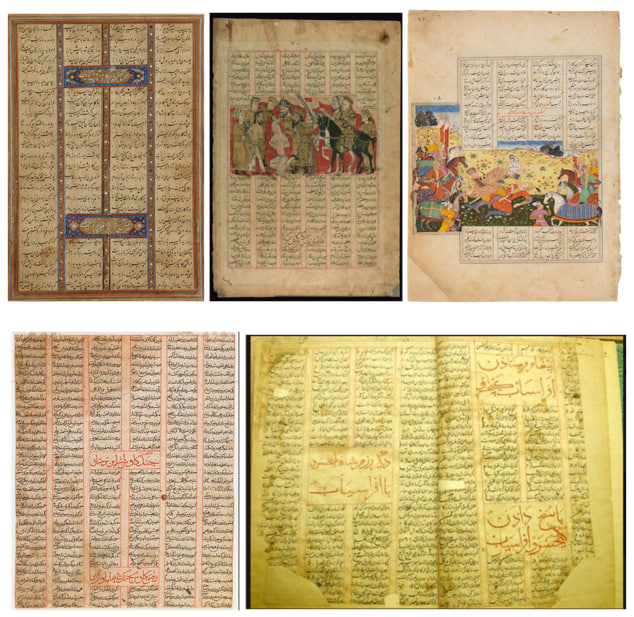
A review of historical written documents suggests that Iranian written culture possessed its own kind of grammar and visual structure.
In terms of content as well, from Achaemenid inscriptions and wall paintings to Tarikh-e Alam-ara-ye Abbasi and up to the publication of the first issue of Kaghaz-e Akhbar, we encounter numerous written works that functioned in some ways as narratives and records of events, reports, and repositories of political and social information. They often contained titles, introductions, descriptions of events, and conclusions—at times resembling the role played by official newspapers or government news agencies today.
Titles also often conveyed specific communication functions. Examples include “Afrasiab Sends a Message to Kaykhosrow,” “The Reign of Fereydun,” and “Sohrab Is Killed by Rostam” in the Shahnameh, or titles such as “The King Who Tested Two Newly Purchased Slaves” and “The Story of the Lover Who Found Himself in His Beloved’s Garden” in manuscripts of the Masnavi.
These are clearly not “headlines” in the modern sense, but their communicative function is worth considering: naming the subject of a narrative or event, distinguishing its elements in terms of who, where, and what, highlighting particular aspects, and guiding the reader.
Encounter Between the Visual Expression of a Tradition and a Global Form
With the arrival of Kaghaz-e Akhbar, existing visual traditions interacted with the new format.
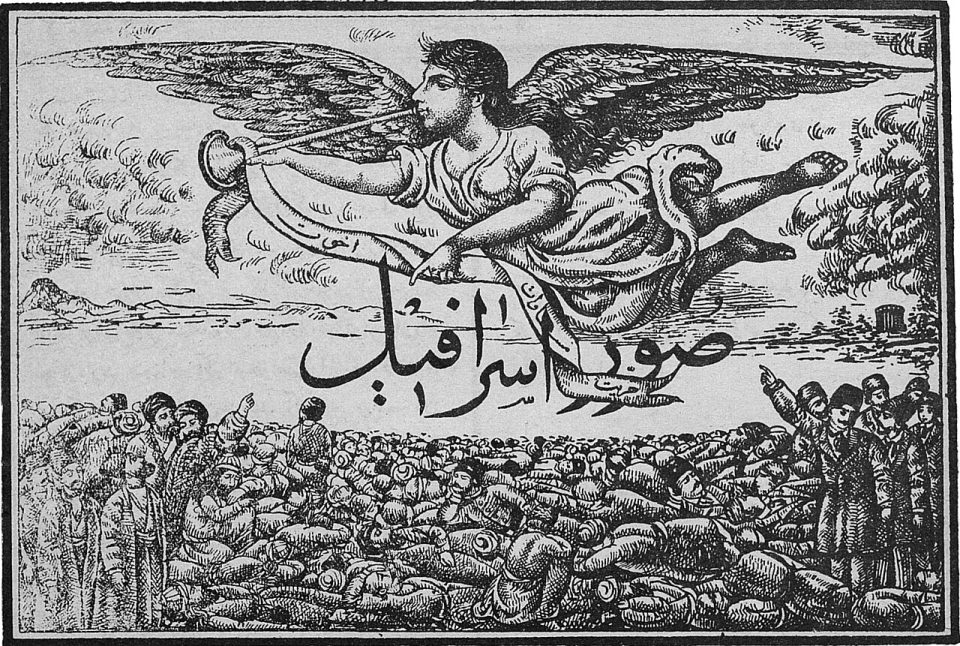
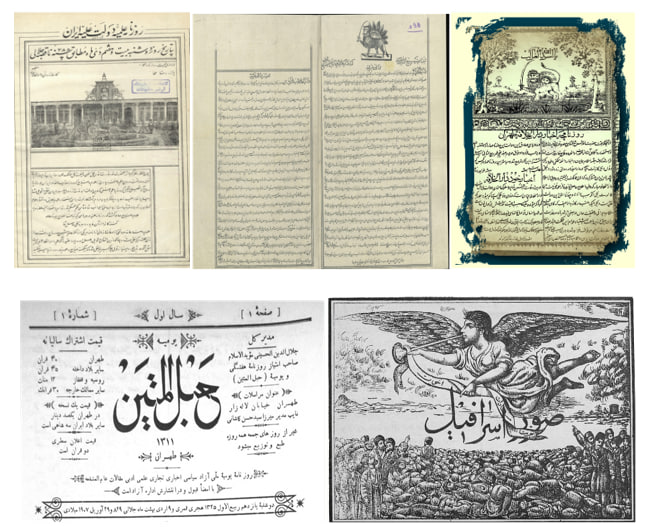
Early Iranian newspapers—including Kaghaz-e Akhbar, Vaqaye’-e Ettefaqiyeh, Sur-e Esrafil, and many others—initially possessed distinctly Iranian names or visual identities.
Their mastheads prominently featured indigenous designs and national or religious slogans. For example, Vaqaye’-e Ettefaqiyeh featured the Lion and Sun along with the inscription “Asadollah al-Ghaleb” (“Ali, the victorious Lion of God”), while the name Habl al-Matin drew on religious themes.
Their written script was often Nasta’liq, and the writing style, arrangement of text, columns, and page design bore considerable resemblance to earlier written works.
Over time, columns, headlines, photographs, page layouts, professional news-writing standards, and other conventions of modern journalism were adopted. As printing technology evolved, particularly with the transition from lithography, newspapers became increasingly global in their visual appearance.
Yet this transformation did not completely erase the earlier visual memory.
Mastheads and newspaper lettering remain one of the clearest examples. Today, almost every formal element of a Persian newspaper page may follow international conventions, while the newspaper’s name continues to appear at the top of the page in a script rooted in Iranian calligraphic traditions, whether Nasta’liq, Naskh, or calligraphic painting.
The argument is not that there is a direct historical relationship between ancient manuscript design and modern newspaper layout. Rather, the survival and recreation of elements of Iran’s aesthetic and written heritage within the new media form is evident and undeniable.
The formal modernization of Iranian newspapers did not necessarily result in a complete break with the country’s previous visual memory.
Fundamental Attachments: Iran and the People
Although every formal and visual feature may carry its own significance and message in terms of identity, the next question is whether the content of influential media and important experiences in Iranian journalism—from Kaghaz-e Akhbar to the present—contains recurring themes that reflect a distinctive cultural and identity-based character.
Unfortunately, many Iranian newspapers and media outlets have been short-lived. Yet, like a relay race, those that survived appear to have inherited a legacy from those that came before them through intergenerational continuity.
One more recent example is the tradition and experience that passed from the newspaper Ayandegan to Azadegan, then to Abrar, and ultimately to Akhbar.
A review of founding statements, editorials, positions, and activities of influential media outlets—from Kaghaz-e Akhbar and Vaqaye’-e Ettefaqiyeh to Mozaffari, Sur-e Esrafil, Ettelaat, Kayhan, and, in the contemporary era, organizations such as ISNA—reveals recurring orientations despite their fundamental historical, political, and professional differences.
Founding statements are particularly important because they reveal both the founders’ motivations and self-understanding and what, in each period, was considered an acceptable, desirable, or defensible mission and purpose for a media organization.
The announcement of the publication of Kaghaz-e Akhbar in 1252 AH stated that its purpose was to educate the inhabitants of the kingdom and make them aware of world affairs. It promised to publish news from the East and West and distribute it throughout the country, particularly information that could increase people’s knowledge, awareness, and understanding.
The stated objectives of Vaqaye’-e Ettefaqiyeh, also known as the “Newspaper of the News of the Capital, Tehran,” included educating the people of Iran and informing them about domestic affairs and foreign events, thereby increasing their knowledge and awareness and preventing false news and rumors.
Mirza Ali-Aqa Shirazi, known as Habib al-Molk, published Mozaffari in Bushehr in 1280 Solar Hijri. Its masthead stated that the newspaper would discuss events, news, useful subjects relating to industry and commerce, scientific articles and literature, and any matter involving public benefit, national interests, and the interests of the country. It also declared that impartial writings serving the public good and not contrary to religion or the state would be accepted and published.
The stated principles of Sur-e Esrafil included supporting the Constitutional Assembly, assisting villagers, the weak, the poor, and the oppressed, and remaining steadfast “to the last breath.” It declared that life without freedom, equality, and honor had no value, and that it would neither be bribed nor engage in unjustified praise or criticism. Its famous principle was essentially: write of what is bad as bad and what is good as good.
In Habl al-Matin, we read a prayer asking God to illuminate their hearts with the light of knowledge so that they would not deviate from the “straight path of truth-telling and truth-writing.” The paper declared that its purpose was the welfare of the nation, the benefit of the state, the advancement of the homeland, and the interests of fellow citizens, while also expressing support for Islam and the dignity of the Muslim community.
The founder of Ettelaat, in the editorial of its first issue on July 10, 1926, explicitly described it as “a national institution that relies on nothing but public opinion.” Before publishing the newspaper, he had envisioned establishing a news center that would open communications with the world and grow sufficiently to compete with foreign news agencies. He described the institution’s ultimate goals as the reform and advancement of the country, its dignity and progress, and the preservation of national interests.
Nearly a century later, a similar aspiration—achieving domestic and international media authority—was expressed by the managing editor of Shargh, a post-Revolution newspaper. He explained that he had always wondered why Iran should not have an international media organization. He therefore launched the newspaper nationally with the goal of eventually expanding it regionally and internationally, hoping that one day it would gain global authority.
Although the founder of Ettelaat initially intended to establish a news agency and only created a newspaper because of obstacles, this bears an interesting resemblance to what was later pursued in the establishment of ISNA under the slogan “Iran as Told by Iran.”
Alongside reporting events in Iran and the world, ISNA introduced a new window into professional news coverage through the slogan “Every Idea, a News Story” and its reliance on a nationwide network of students, eventually becoming a genuine news reference for domestic and foreign media.
What stands out in these historical examples, despite their differences in time, politics, and professional structure, is the repeated return of a set of themes that can ultimately be organized around two major attachments:
“Iran” and “the Iranian people.”
This consistency is significant because these were not homogeneous media organizations. They ranged from a government publication during the Qajar period to the constitutionalist Sur-e Esrafil, Ettelaat during the early Pahlavi era, and Shargh. Their ownership structures, relationships with political power, and professional outlooks were not the same.
Yet references to Iran, the nation, the people, national interests, the public good, and society’s knowledge and awareness repeatedly appeared in their self-definitions, albeit in different language.
“Iran” appeared at different times as the preservation of national independence and territorial integrity, resistance to foreign domination, the advancement and dignity of the country, independent communication with the world, and, in the contemporary period, Iran’s right to have an independent narrative of itself—or “Iran as Told by Iran.”
“The people,” meanwhile, appeared in different forms: educating and enlightening the public; serving the common good; supporting the weak and oppressed; and, more recently, concepts such as freedom, justice, “knowing is the people’s right,” and “a newspaper for everyone” or “a newspaper for civil society.”
Interestingly, even government-controlled or government-aligned media have often appealed to concepts such as “Iran and the people” to legitimize themselves.
Historical Agency as an Element of Change
To understand the identity of a social institution, not every moment in its history can be considered equally explanatory. Institutions reveal their tendencies, capacities, attachments, and contradictions more clearly at turning points and critical junctures.
There is little doubt that the Constitutional Revolution, the nationalization of the oil industry, the 1979 Islamic Revolution, and the reform movement of 1997 are four important moments in Iran’s modern history.
In none of these periods were the media merely spectators. Journalists and media organizations played an active role as agents of change.
In Iran, where governments have historically exercised extensive control over the media, these periods of greater political and social openness—and reduced constraints—provide a better opportunity to observe the natural behavior and identity of the press.
During the Constitutional Revolution, the press became part of the formation of a new public sphere and helped spread the language of law, freedom, national awareness, and criticism of despotism.
During the oil nationalization movement, newspapers such as Bakhtar-e Emruz played a decisive role in debates over independence, national sovereignty, and Iran’s relationship with foreign powers.
During the 1979 Revolution, although the revolution’s communications network was not primarily composed of official newspapers, journalists contributed through their strikes beginning in the autumn of 1978 and the closure of official newspapers. They helped create space for revolutionary media, including clandestine publications, cassette recordings, and sermons. After the Shah left, many journalists formally joined the revolutionary movement.
The famous coordinated headline “The Shah Has Gone” published by Ettelaat and Kayhan on January 17, 1979, became one of the most enduring media symbols of the collapse of the previous political order.
It was less forceful than the headline of Dr. Fatemi’s Bakhtar-e Emruz in 1953, which declared that “the traitor who wanted to drag the homeland into blood and destruction has fled.” Nevertheless, after 25 years, it reflected a meaningful semantic kinship and convergence.
During the reform era beginning in 1997, headlines such as “Khatami Has Come” and “Hello to Society” accompanied the emergence of dozens of newspapers and hundreds of new journalists, leading to what became known as the “spring of the Iranian press.”
The press itself became one of the country’s most important arenas for debate over freedom, civil society, the right to know, participation, criticism of power, and change.
Across all these periods, one recurring historical pattern cannot easily be ignored:
The pursuit of freedom, the defense of independence, resistance to despotism, public awareness and awakening, progress, and change repeatedly entered the language and practice of Iran’s influential media, albeit in different forms.
The media were undoubtedly among the principal forces behind transformation in all these periods.
The selection of these four periods, however, is not intended as a predetermined sample designed to prove the role of the media. Rather, these periods were selected because of their historical significance, their capacity to test the hypothesis, and their exceptional ability to reveal underlying tendencies.
When one orientation—support for change desired by the people—repeatedly appears across four fundamentally different transformations over nearly two centuries, it becomes possible to hypothesize that we are not dealing merely with accidental behavior, but perhaps with part of the normative heritage and historical character of Iranian journalism.
This does not mean that all Iranian newspapers have been freedom-oriented, independent, or consistently populist.
Nor has it ever been claimed that every journalist in Iran embodies the characteristics of Iranian journalism.
Just as the existence of thousands of buildings without elements of Iranian architecture does not disprove the existence of Iranian architecture, and films without distinctive Iranian characteristics do not disprove the existence of Iranian cinema, the existence—even in large numbers—of media outlets lacking these characteristics does not necessarily disprove the existence of an Iranian journalistic tradition or identity.
One might argue that patriotism, populism, freedom, and independence are not uniquely Iranian. French, Indian, Japanese, Russian, and American journalism can also be populist, independent, or freedom-oriented.
Yes. A combination of characteristics within each society creates that society’s identity.
No single musical note, by itself, constitutes Iranian music. No particular color, curve, or building material belongs exclusively to Iranian architecture or is sufficient on its own to create Iranian architecture.
Identities emerge from the combination of elements, the relationships among them, their relative weight, the historical memory they carry, and the way they manifest themselves within a social experience.
Therefore, the more precise question is not whether populism exists elsewhere, but rather:
What meaning has “the people” acquired in the history of Iranian journalism? What relationship has it established with “Iran”? At which turning points has it emerged? And how has it combined with concepts such as freedom, independence, progress, and criticism of power?
From this perspective, based on the evidence presented, “Iran,” “the people,” and playing a role as “an element of change” can currently be understood as two fundamental attachments and one traceable historical function within the Iranian journalistic tradition—not as exclusive characteristics of Iranian journalism.
Civilizational Norms: Literary and Visual Civility
Alongside Iran, the people, and the historical role of participating in change, a review of early documents highlights a fourth and fifth strand, different in nature but nevertheless important: what might be called “literary civility” and “respect for spirituality.”
By literary civility, we mean a norm that distinguishes between frankness and abuse, criticism and humiliation, intellectual disagreement and vulgar writing.
Our literary heritage, alongside its extraordinary richness and achievements, has also contained satire, insults, vulgarity, and explicit writing. Examples can be found throughout literary history, from Suzani Samarqandi, Obeyd Zakani, Rumi, and Saadi to Iraj Mirza and others.
However, although Iranian journalism has been deeply influenced by Persian literature, vulgarity never became the dominant professional norm within a significant portion of Iran’s formal press tradition, despite intense political conflicts.
“The ethics of the pen” remained a value.
This is notable because Iranian books and cinema in certain periods were less protected from this phenomenon, while many Western media cultures have also openly incorporated vulgarity.
To clarify the point concerning civility in Iranian journalism, the article refers to a dialogue published in the second issue of Sur-e Esrafil, titled “Q&A at the Ministry of Science and Endowments.”
When the minister criticized the newspaper for its attacks on the government and asked why historical events were being written about “in this way,” Mirza Jahangir Khan Sur-e Esrafil responded that he had not departed from the bounds of literary propriety and emphasized that nothing had been written contrary to decency.
His statement, made during a political dispute, is significant because it reflects a degree of self-awareness and an attempt to maintain a boundary between criticism of power and personal vulgarity.
This principle can be seen throughout Dehkhoda’s famous column “Charand-o Parand” and, arguably, remains part of the dominant current of Iranian journalism today.
Despite harsh language, occasional departures from fairness, and even instances of falsehood and slander, vulgar writing has not become dominant in Iranian journalism.
Visual Explicitness
Similarly, explicit sexual representation has generally not become the dominant norm within Iran’s cultural environment, except in certain newspapers during the Pahlavi period, particularly during the 25 years following the 1953 coup.
Neither from the Constitutional Revolution to August 1953 nor from 1979 to the present has it appeared to any significant extent.
This has been influenced both by social customs and cultural norms and, of course, by legal restrictions.
In many contemporary media cultures, particularly in the West, explicit sexual imagery and language in newspapers, cinema, and other media products are commonplace and socially accepted—and sometimes actively promoted.
Over two centuries, however, Iran’s media environment, despite occasional verbal exceptions, has generally not adopted such an approach as a dominant norm. Iranian media have therefore generally not been considered visually “explicit.”
Spiritual Dimensions
In the same context, given the long-standing religious and spiritual orientation in Iran’s civilizational history—from Zoroastrianism to Islam—the visual and substantive distinctions in Iranian cultural production, particularly written works, compared with societies where secularism or laïcité has become more dominant in public culture are understandable.
As noted earlier, religious literary and visual elements were evident in the mastheads and editorials of the first generation of Iranian newspapers.
Mozaffari stipulated that its content should not conflict with religion or the state. Habl al-Matin spoke of supporting “the sacred religion of Islam.” The visual appearance of early newspapers likewise contained religious symbols and names.
Even during the Pahlavi era, despite the dominance of a secular environment, overt attacks on religious or spiritual sanctities were relatively uncommon in major media, even when those publications themselves were not religious.
After 1979, an unprecedented volume of cultural and religious textual and visual content appeared, either explicitly or indirectly, from mastheads to articles, particularly around religious occasions.
The spectrum ranged from newspapers such as Resalat, which defined its mission as promoting God’s message and preparing the ground for the full implementation of religious principles, to newspapers closer to secular culture that did not consider themselves religious institutions.
Nevertheless, the use of religious imagery, respect and restraint toward spiritual and moral sanctities, avoidance of blasphemy, and avoidance of promoting activities considered religiously forbidden—such as alcohol consumption—have, in varying degrees and forms and under the influence of social conditions, national beliefs, and laws, constituted one of the prominent strands worthy of examination in the evolution of the Iranian press.
Furthermore, certain religious ethical teachings—such as fairness, bearing witness to the truth, honesty, and avoiding lies, slander, and false accusations—have aligned with several universal principles of professional journalistic ethics.
Of course, these same teachings and the laws derived from them have also placed limitations on critical journalism, particularly regarding religion and religious government.
Definitions of national security, public disturbance, and privacy have likewise significantly narrowed the scope of media intervention, disclosure, and investigative journalism in these areas.
Our Relationship With a Historical Identity
If, as Habl al-Matin put it, the media remain on the “straight path of truth-telling and truth-writing,” then attachment to Iran and its people, together with a role in social transformation, can contribute to the progress of the homeland, the welfare of the nation, independence, and media authority.
It can also help prevent passivity in the face of hegemonic media.
Alongside these three elements, “civility of the pen” can, in an age of easy and mass-produced misinformation, unethical behavior, hatred, humiliation, and polarization, become not merely a literary virtue but part of the mechanism through which media promote truth and build trust.
Iranian symbols and respect for spiritual values can also connect the modernization of journalism with Iran’s communications heritage and historical and cultural memory.
At the same time, it must once again be emphasized that the intention is not to glorify everything historical.
Dependence, censorship, power-centeredness, and the elimination of alternative voices have also been part of the history of Iranian media.
A deeper identification of the characteristics of Iranian journalism requires systematic study of the press across different periods, broader content analysis, examination of media that do not fit the proposed model, comparison of periods of openness and restriction, and potentially comparative research with other journalistic cultures.
The legal environment surrounding the media in Iran—including press laws, copyright, and other regulations governing media activity—must also be examined.
Nevertheless, the evidence gathered so far allows us to advance the hypothesis of the previous article one step further:
Over these two centuries, Iran’s journalistic community has created its own educational, legal, and professional structures, albeit imperfectly. Today, with a broad community of professors, students, and journalists throughout the country, it possesses an established and mature institutional existence and character.
Modern journalism in Iran, like Iranian cinema, has not been and is not merely a copied version of an imported profession or technology.
Alongside the arrival of new technologies and knowledge and its exposure to external cultural values and models, Iranian journalism has developed its own form and character through its encounter with the country’s history, language, culture, political experience, and social life.
The purpose of this inquiry is not to invent new principles for journalism in Iran or to manufacture an identity for national and Iranian journalism.
The purpose is to invite a deeper understanding of our relationship with nearly two centuries of Iranian journalistic endeavor and to identify its key concerns and identity-forming elements.
An endeavor that, despite all its diversity and plurality, from Kaghaz-e Akhbar to the present, demonstrates an attachment to two fundamental principles—“Iran” and “the people”—adherence to two norms—“literary and visual civility” and “spiritual respect”—and ultimately a historical function: “playing a role in bringing about change.”
It is an endeavor that has been part of a continuing concern that today can be called “Iran as Told by Iran,” with the hope that it can reclaim and strengthen its broader role in “the world as told by Iran.”
Clearly, developing ways to identify, strengthen, and recreate the valuable aspects of these identity-forming elements—particularly in the digital age and on social media—is another important challenge expected to engage the country’s broader media community.
August 29, 2026
Abolfazl Fateh and Hossein Entezami