


Shafaqna English- Commentary on the 2nd Chapter of the Holy Quran by Mohammad Sobhanie.
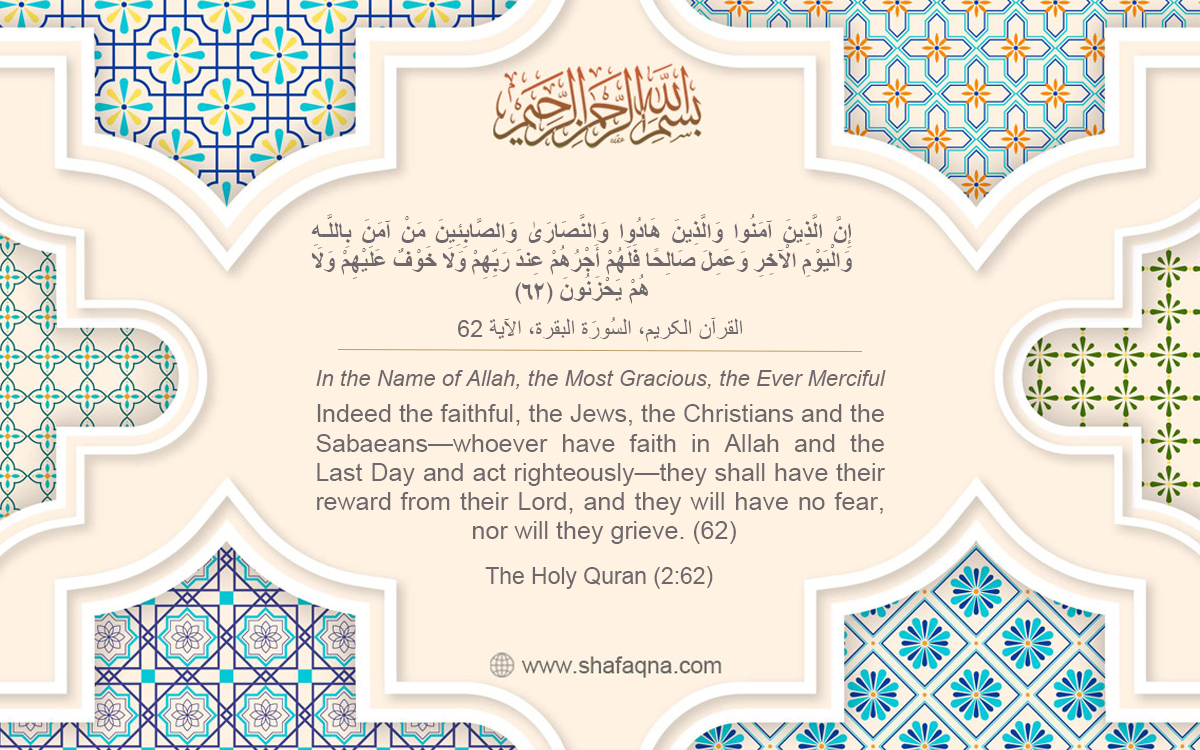
إِنَّ الَّذِينَ آمَنُوا وَالَّذِينَ هَادُوا وَالنَّصَارَىٰ وَالصَّابِئِينَ مَنْ آمَنَ بِاللَّـهِ وَالْيَوْمِ الْآخِرِ وَعَمِلَ صَالِحًا فَلَهُمْ أَجْرُهُمْ عِندَ رَبِّهِمْ وَلَا خَوْفٌ عَلَيْهِمْ وَلَا هُمْ يَحْزَنُونَ ﴿٦٢﴾
2:62 Indeed the faithful, the Jews, the Christians and the Sabaeans—whoever have faith in Allah and the Last Day and act righteously—they shall have their reward from their Lord, and they will have no fear, nor will they grieve.
2:62 Religious Tolerance vs. Pluralism
Commentary: Verse 2:50 declares that eternal prosperity and happiness depends on having faith in Allah (SWT) (آمَنَ بِاللَّـهِ) and the Day of Judgment (وَالْيَوْمِ الْآخِرِ), accompanied by performing righteous deeds (وَعَمِلَ صَالِحًا). This fact is true for everyone, including Muslims, Jews, Christians, and followers of other divine messengers such as the Sabeans[1]. This principle is also mentioned in chapter Al-Maidah 5:69:
إِنَّ الَّذِينَ آمَنُوا وَالَّذِينَ هَادُوا وَالصَّابِئُونَ وَالنَّصَارَىٰ مَنْ آمَنَ بِاللَّـهِ وَالْيَوْمِ الْآخِرِ وَعَمِلَ صَالِحًا فَلَا خَوْفٌ عَلَيْهِمْ وَلَا هُمْ يَحْزَنُونَ ﴿٦٩﴾
5:69 Indeed Muslims, Jews, Sabaeans, and Christians—whoever believes in Allah and the Last Day and act righteously – they will not fear, nor will they grieve.
Do these verses (2:62 and 5:69) imply that Muslims, Jews, Christians, or followers of other divine messengers are all equally right before Allah (SWT) on the Day of Judgment, provided they believe in God, the Day of Judgment and act righteously? Answering this question relies on understanding the concept of faith in God, as explained in the Qur’an.
The Concept of Faith in God in the Qur’an [Arabic: (آمَنَ بِاللَّـهِ)]: Belief in God (SWT) means believing in the existence of God, His prophets, and divine scriptures. It is an outlandish claim that one expresses faith in God and, at the same time, denies His messengers or His scriptures.
Allah (SWT) has sent 124,000 messengers, beginning with Prophet Adam (AS) and ending with Prophet Mohammad (SAWA). The mission of each prophet was limited to a specific nation and for a specified period, except Prophet Mohammad (SAWA), who is the divine prophet for all humanity until the end of the time[2]:
قُلْ يَا أَيُّهَا النَّاسُ إِنِّي رَسُولُ اللَّـهِ إِلَيْكُمْ جَمِيعًا … ﴿١٥٨﴾
7-158 Say, ‘O mankind! I am the Messenger of Allah to you all’…
Verse 2:62 asserts that whoever has faith in the Prophet of the time and the Day of Judgment and does righteous deeds will receive salvation in the Hereafter.
For instance, Prophet Musa (AS) came to the Children of Israel first. Those who believed in him and practiced the teachings of the Taurat will receive salvation in the Hereafter. Later, Prophet Isa (AS) was the Prophet to the Israelites. Those who believed in him and practiced the teachings of the Bible will have their reward with their Lord. Those who denied him rejected the messenger of their time and could no longer expect salvation in the Hereafter.
Currently, Prophet Mohammad (SAWA) is the last divine messenger, and the Qur’an is the final revelation. Accordingly, Islam is the religion of salvation now. Unaware and heedless people will be judged fairly in the Hereafter[3]. This understanding is clearly echoed in chapter Al-Maida (5:68):
قُلْ يَا أَهْلَ الْكِتَابِ لَسْتُمْ عَلَىٰ شَيْءٍ حَتَّىٰ تُقِيمُوا التَّوْرَاةَ وَالْإِنجِيلَ وَمَا أُنزِلَ إِلَيْكُم مِّن رَّبِّكُمْ وَلَيَزِيدَنَّ كَثِيرًا مِّنْهُم مَّا أُنزِلَ إِلَيْكَ مِن رَّبِّكَ طُغْيَانًا وَكُفْرًا فَلَا تَأْسَ عَلَى الْقَوْمِ الْكَافِرِينَ ﴿٦٨﴾
5:68 Say, “O People of the Scripture, you are (standing) on nothing until you uphold (the law of) the Torah, the Gospel, and what has been revealed to you from your Lord (The Qur’an).” And that which has been revealed to you from your Lord will surely increase many of them in transgression and disbelief. So do not grieve over the disbelieving people.
In conclusion, the Qur’an and the traditions of the Prophet (SAWA) advocate for religious liberty. History is testimony to this fact. Muslims, Jews, and Christians lived together in harmony and each religious group peacefully worshipped God as they pleased. At the same time however, Islam does not concede to competing beliefs regarding God and salvation.
For instance, Muslims, Jews, and Christians agree on the existence of God, yet each religion defines God differently and holds irreconcilable beliefs.
Word-for-Word Translation:
2:62 [إِنَّ] Indeed, [الَّذِينَ] those who [آمَنُوا] believed [وَالَّذِينَ] and those who [هَادُوا] became Jews [وَالنَّصَارَىٰ] and the Christians [وَالصَّابِئِينَ] and the Sabians [مَنْ] who [آمَنَ] believed [بِاللَّـهِ] in Allah [وَالْيَوْمِ] and the Day [الْآخِرِ] the Last [وَعَمِلَ] and did [صَالِحًا] righteous deeds [فَلَهُمْ] so for them [أَجْرُهُمْ] their rewards [عِندَ] is with [رَبِّهِمْ] their Lord [وَلَا] and no [خَوْفٌ] fear [عَلَيْهِمْ] on them [وَلَا] and not [هُمْ] they [يَحْزَنُونَ] will grieve.
Note:
[1]. Sabeans are Followers of Prophet Yahya (John), Noah or Ibrahim, Tafseer-e-Namoona, Vol.1, Page 282, L. 6.
[2]. Al-Araf 7:158.
[3]. Al-Hajj 22:17.
- Previous version: Religious Tolerance vs. Pluralism: Commentary of the Quran (Chapter 2:62) By: Mohammad Sobhanie
- Part of series: Commentary of the Quran by Mohammad Sobhanie
- Directory of Surah Al-Baqarah
Living with Dignity: Commentary on Holy Quran (2:61)