

Shafaqna English- Commentary on the 2nd Chapter of the Holy Quran by Mohammad Sobhanie.
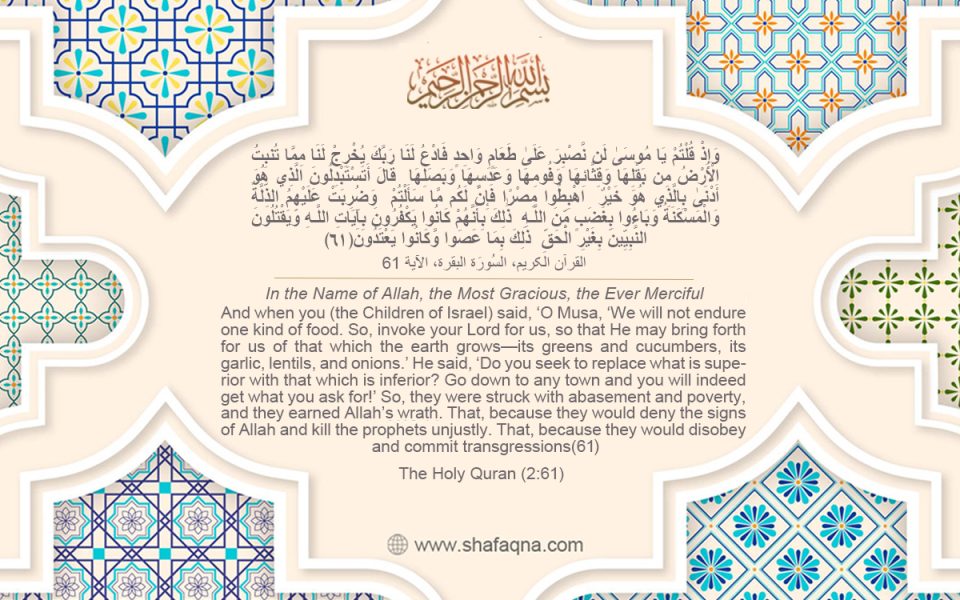
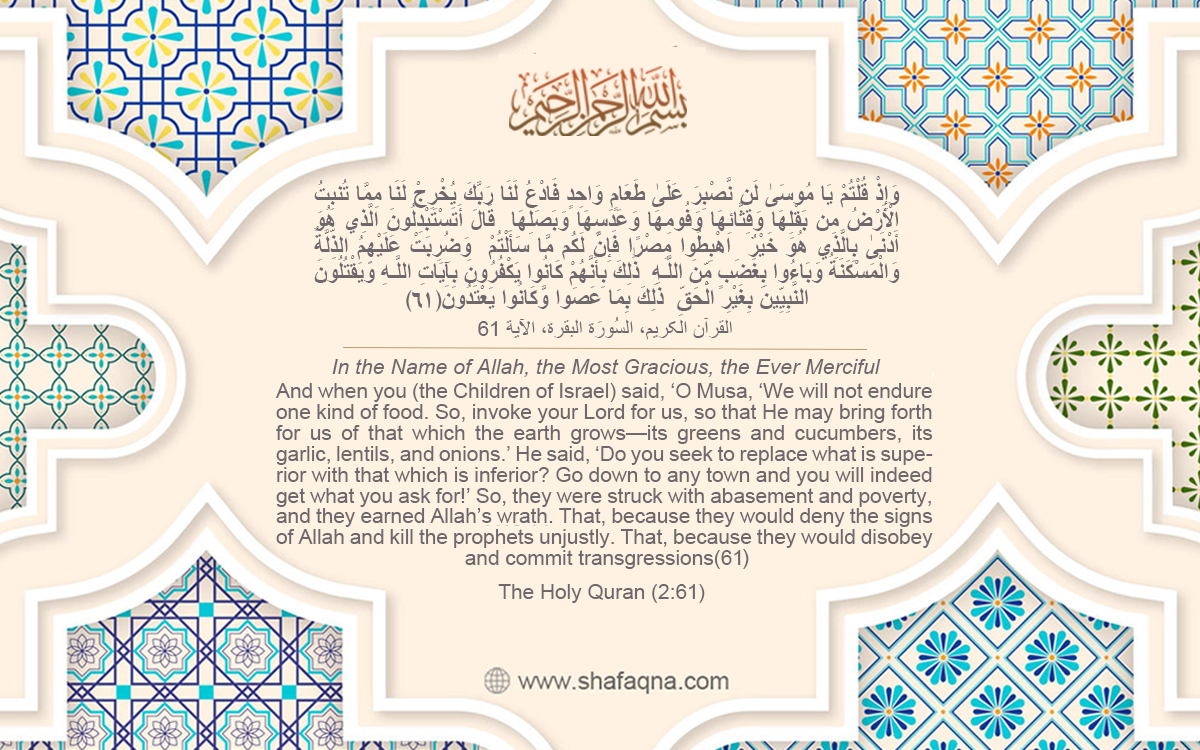
وَإِذْ قُلْتُمْ يَا مُوسَىٰ لَن نَّصْبِرَ عَلَىٰ طَعَامٍ وَاحِدٍ فَادْعُ لَنَا رَبَّكَ يُخْرِجْ لَنَا مِمَّا تُنبِتُ الْأَرْضُ مِن بَقْلِهَا وَقِثَّائِهَا وَفُومِهَا وَعَدَسِهَا وَبَصَلِهَا قَالَ أَتَسْتَبْدِلُونَ الَّذِي هُوَ أَدْنَىٰ بِالَّذِي هُوَ خَيْرٌ اهْبِطُوا مِصْرًا فَإِنَّ لَكُم مَّا سَأَلْتُمْ وَضُرِبَتْ عَلَيْهِمُ الذِّلَّةُ وَالْمَسْكَنَةُ وَبَاءُوا بِغَضَبٍ مِّنَ اللَّـهِ ذَٰلِكَ بِأَنَّهُمْ كَانُوا يَكْفُرُونَ بِآيَاتِ اللَّـهِ وَيَقْتُلُونَ النَّبِيِّينَ بِغَيْرِ الْحَقِّ ذَٰلِكَ بِمَا عَصَوا وَّكَانُوا يَعْتَدُونَ ﴿٦١﴾
2:61 And when you (the Children of Israel) said, ‘O Musa, ‘We will not endure one kind of food. So, invoke your Lord for us, so that He may bring forth for us of that which the earth grows—its greens and cucumbers, its garlic, lentils, and onions.’ He said, ‘Do you seek to replace what is superior with that which is inferior? Go down to any town and you will indeed get what you ask for!’ So, they were struck with abasement and poverty, and they earned Allah’s wrath. That, because they would deny the signs of Allah and kill the prophets unjustly. That, because they would disobey and commit transgressions.
2:61 Living with Dignity
Commentary: After Prophet Musa (AS) received the tablets of the law, Allah (SWT) directed the Children of Israel to depart from the Sinai Peninsula to the Holy Land (الْأَرْضَ الْمُقَدَّسَةَ)[1]. The Amalekites[2], a brutal nation, lived in that region at that time, and the Israelites could not claim the land without defeating them.
Fear of the Amalekites dissuaded the Children of Israel from entering the land. Hence, they defied the divine command and consequently were condemned to rove in the desert of the Sinai Peninsula for 40 years, as they could not return to Egypt to live as slaves again.
Despite their defiance, Allah (SWT) protected the Israelites from the blistering heat of the sun by a canopy of light clouds that hovered over their heads. He provided them springs of pure water amidst the wilderness of the desert[3] and food and sustenance in the forms of “Al-manna” and “al-Salwa” [Arabic: (الْمَنَّ وَالسَّلْوَىٰ)]. Al-manna was natural honey or a natural sweet substance found in the Sinai Peninsula, and al-Salwa was a small bird about the size of a pigeon[4].
The Israelites were longing the delicacies of Egypt they had left behind. Once, they complained to Prophet Musa (AS) that they no longer could bear one kind of food. They asked him to call upon his Lord to make the barren land of Sinai produce edible vegetables such as green herbs, cucumbers, garlic, lentils, and onions.
The Prophet Musa (AS) replied, “Would you take an inferior thing in exchange for the better one? If that is the case, then go back with indignity to any town (like Egypt[5]), and then you could have what you are asking for!”
… قَالَ أَتَسْتَبْدِلُونَ الَّذِي هُوَ أَدْنَىٰ بِالَّذِي هُوَ خَيْرٌ اهْبِطُوا مِصْرًا فَإِنَّ لَكُم مَّا سَأَلْتُمْ … ﴿٦١﴾
2:61 …He said, ‘Do you seek to replace what is superior with that which is inferior? Go down to any town and you will indeed get what you ask for!’…
The Children of Israel could find a variety of foods either in the Promised Land or any other city like Egypt. However, they refused to march towards the Promised Land, live there with honour and dignity, and enjoy its variety of foods and fruits. The alternative was to return to Egypt but live while enslaved.
Prophet Musa (AS) asked the Israelites which choice was better: to live free with honour and dignity in the wilderness at the price of tolerating only one kind of food, or living as a slave enjoying the delicacies?
The Children of Israel who left Egypt were raised in slavery and servitude. Firon inflicted the worst kind of cruelty and oppression upon them. He slaughtered their sons, took their females as bondwomen, and forced their males to perform excruciating work. Therefore, they steadily became timid, weak-minded, and cowardly nations. Lack of faith in the words of Prophet Musa (AS) unfortunately hindered the Israelites in overcoming their fear of the Amalekites.
Word-for-Word Translation:
2:61 [وَإِذْ] And when [قُلْتُمْ] you said [يَا مُوسَىٰ] O Musa [لَن] never will [نَّصْبِرَ] we endure [عَلَىٰ] on [طَعَامٍ] food [وَاحِدٍ] of one kind [فَادْعُ] so pray [لَنَا] for us [رَبَّكَ] to your Lord [يُخْرِجْ] to bring forth [لَنَا] for us [مِمَّا] out of what [تُنبِتُ] grows [الْأَرْضُ] the earth [مِن] of [بَقْلِهَا] its herbs [وَقِثَّائِهَا] and its cucumbers [وَفُومِهَا] and its garlic [وَعَدَسِهَا] and its lentils [وَبَصَلِهَا] and its onions [قَالَ] He said [أَتَسْتَبْدِلُونَ] would you exchange [الَّذِي] that which [هُوَ] it [أَدْنَىٰ] is inferior [بِالَّذِي] for that which [هُوَ] it [خَيْرٌ] is better [اهْبِطُوا] Go down [مِصْرًا] to a city [فَإِنَّ] so indeed [لَكُم] for you [مَّا] is what [سَأَلْتُمْ] you have asked for [وَضُرِبَتْ] And were struck [عَلَيْهِمُ] on them [الذِّلَّةُ] the humiliation [وَالْمَسْكَنَةُ] and the misery [وَبَاءُوا]and they drew on themselves [بِغَضَبٍ] wrath [مِّنَ] of [اللَّـهِ] Allah [ذَٰلِكَ] That was [بِأَنَّهُمْ] because they [كَانُوا] used to [يَكْفُرُونَ] disbelieve [بِآيَاتِ] in the signs [اللَّـهِ] of Allah [وَيَقْتُلُونَ] and kill [النَّبِيِّينَ] the prophets [بِغَيْرِ] without any [الْحَقِّ] the right [ذَٰلِكَ] that [بِمَا] was because [عَصَوا] they disobeyed [وَّكَانُوا] and they were [يَعْتَدُونَ] transgressing
Note:
[1]. Tafseer-e- Namonah Vol.1 Page 260, L. 13.
[2]. Al-Ma’ida 5:21-26 [Arabic: (قَوْمًا جَبَّارِينَ)].
[3]. Al-Baqara 2:57 and 60.
[4]. Tafseer-e-Namoona, Vol. 1, P.263, L. 17.
[5]. The word Misr [Arabic: (مِصْرًا)] with tanwin is an indefinite noun and it could refer to any Egypt, i.e., any country as fertile as Egypt.
- Previous version: Living with Dignity: Commentary of the Quran (Chapter 2:61) By: Mohammad Sobhanie
- Part of series: Commentary of the Quran by Mohammad Sobhanie
- Directory of Surah Al-Baqarah
Miracle of water gushing forth in desert: Commentary on Holy Quran (2:60)