


Shafaqna English- Commentary on the 2nd Chapter of the Holy Quran by Mohammad Sobhanie.
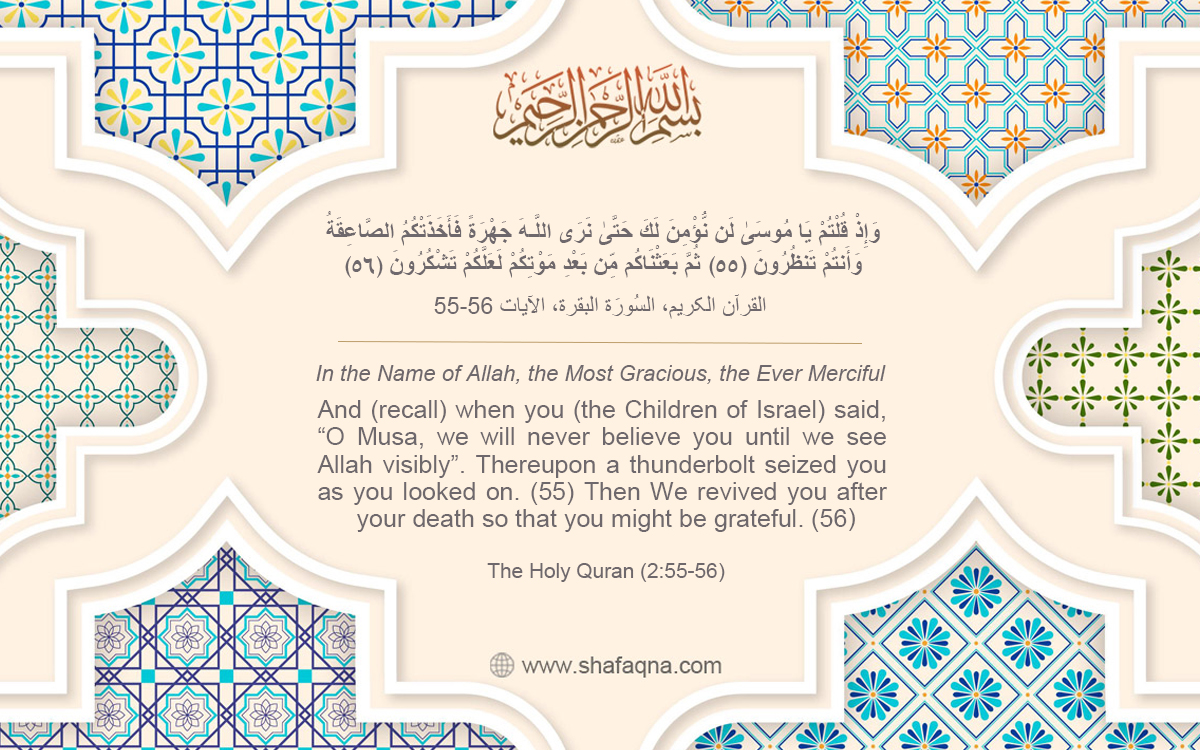
وَإِذْ قُلْتُمْ يَا مُوسَىٰ لَن نُّؤْمِنَ لَكَ حَتَّىٰ نَرَى اللَّـهَ جَهْرَةً فَأَخَذَتْكُمُ الصَّاعِقَةُ وَأَنتُمْ تَنظُرُونَ ﴿٥٥﴾ ثُمَّ بَعَثْنَاكُم مِّن بَعْدِ مَوْتِكُمْ لَعَلَّكُمْ تَشْكُرُونَ ﴿٥٦﴾
2:55 And (recall) when you (the Children of Israel) said, “O Musa, we will never believe you until we see Allah visibly”. Thereupon a thunderbolt seized you as you looked on.
2:56 Then We revived you after your death so that you might be grateful.
2:55 Irrational Demand
Commentary: Prophet Musa (AS) and the Children of Israel miraculously crossed the Nile River (Red Sea) and arrived at the Sinai Peninsula. Soon after, Allah (SWT) called Prophet Musa (AS) to Mount Sinai[1] so that Prophet Musa (AS) may receive the law of the Taurat (Torah).
Prophet Musa (AS) was concerned that pessimists or malicious individuals would question the authenticity of the Taurat and raise this question in people’s minds: had Musa (AS) indeed received the Taurat from God? He decided to circumvent this problem by taking 70 witnesses from the Children of Israel[2] on his journey to Mount Sinai[3].
Prophet Musa (AS) spent 40 nights on the mountain, worshipping Allah (SWT) in seclusion without distractions. This opportunity provided him with a transcendent spiritual readiness to receive divine revelation. During his stay, Allah (SWT) inscribed to him divine tablets of law[4].
One might expect that Prophet Musa’s companions were ecstatic to witness the unique and historical moments of the revelation of the Taurat (Torah). Instead, they said:
… يَا مُوسَىٰ لَن نُّؤْمِنَ لَكَ حَتَّىٰ نَرَى اللَّـهَ جَهْرَةً … ﴿٥٥﴾
2:55 …”O Musa, we will not believe (that) you (received the tablets of law from God) until we see Allah visibly…”
This request put Prophet Musa (AS) in an uncomfortable position. On the one hand, God is unperceivable; how could he ask Allah (SWT) to manifest Himself? On the other hand, how could he convince the Children of Israel that the tablets of the law were from God Himself if His companions did not believe in him?
Naturally, Prophet Musa (AS) tried to convince the Children of Israel that it was impossible to see God. However, they insisted on their irrational demand. Their stubbornness brought the wrath of Allah (SWT). A thunderbolt and an earthquake[5] seized them, and they perished:
… فَأَخَذَتْكُمُ الصَّاعِقَةُ وَأَنتُمْ تَنظُرُونَ ﴿٥٥﴾
2:55 So the thunderbolt took you while you were looking on.
The statement “while you were looking on” (وَأَنتُمْ تَنظُرُونَ) implies that the Children of Israel witnessed their divine punishment firsthand.
The Aftermath of the Death of the Israelites: The death of the 70 Israelites created another dilemma for Prophet Musa (AS). Would the other Israelites believe his narration that a thunderbolt destroyed his companions since they wanted to see God in person? Most probably not, as his 70 perished companions did not believe him. Perhaps, for this reason, he asked Allah (SWT) to resurrect his perished companions, a plea which He accepted in His mercy towards Musa’s request:
ثُمَّ بَعَثْنَاكُم مِّن بَعْدِ مَوْتِكُمْ لَعَلَّكُمْ تَشْكُرُونَ ﴿٥٦﴾
2:56 Then We revived you after your death so that you might be grateful.
The phrase “…that you might give thanks” (لَعَلَّكُمْ تَشْكُرُونَ) implies expressing gratitude for a new life after death.
Genuine vs. Stubborn Skepticism: Doubt precludes the discovery of truth. In general, truth is reached through a process involving logic and reason. There is a difference between genuine doubt and stubborn skepticism.
A genuine skeptic asks a logical question and makes a reasonable demand, whereas a stubborn skeptic thinks illogically and mandates an unreasonable request. For instance, the Children of Israel asked Musa (AS) to show them God in person. How could Musa (AS) show them an unperceivable God?
An example of a reasonable demand involves the Qur’an itself. The Holy Qur’an is the word of Allah (SWT), which was revealed to the heart of Prophet Mohammad (SAWA). If one were to claim that the Qur’an is a product of human intellect, the Qur’an, in turn, challenges humankind to produce a chapter like it. This challenge is an instance of a rational demand.
Raj’a: This verse also asserts the possibility of returning from death back to life; this is known as raj’a in the Shia school of Islam. This fact should not be confused with reincarnation. In raj’a, a human soul is reunited with his original body, like the way the dead were brought back to life by Prophet Isa (AS)[6] or the reviving of Prophet Uzair (AS) after 100 years[7]. In contrast, reincarnation is the rebirth of a soul in a new body or a new form of life.
Word-for-Word Translation:
2:55 [وَإِذْ] And when [قُلْتُمْ] you said [يَا مُوسَىٰ] O Musa [لَن] never [نُّؤْمِنَ] will we believe [لَكَ] in you [حَتَّىٰ] until [نَرَى] we see [اللَّـهَ] Allah [جَهْرَةً] visibly [فَأَخَذَتْكُمُ] So seized you [الصَّاعِقَةُ] the thunderbolt [وَأَنتُمْ] while you [تَنظُرُونَ] were looking.
2:56 [ثُمَّ] Then [بَعَثْنَاكُم] we revived you [مِّن] from [بَعْدِ] after [مَوْتِكُمْ] your death [لَعَلَّكُمْ] so that you may [تَشْكُرُونَ] be grateful.
Note:
[1]. Ta-Ha 20:80.
[2]. Al-Araf 7:155.
[3]. Manshoor-e-Javid, Vol.12, Page 156, L. 3.
[4]. Al-Araf 7:145.
[5]. Al-Araf 7:155.
[6]. Al-Imran 49.
[7]. Al-baqara 2:259.
- Previous version: Irrational Demand / Commentary of the Quran (Chapter 2:55-56) By: Mohammad Sobhanie
- Part of series: Commentary of the Quran by Mohammad Sobhanie
- Directory of Surah Al-Baqarah
Living with Dignity: Commentary on Holy Quran (2:61)