

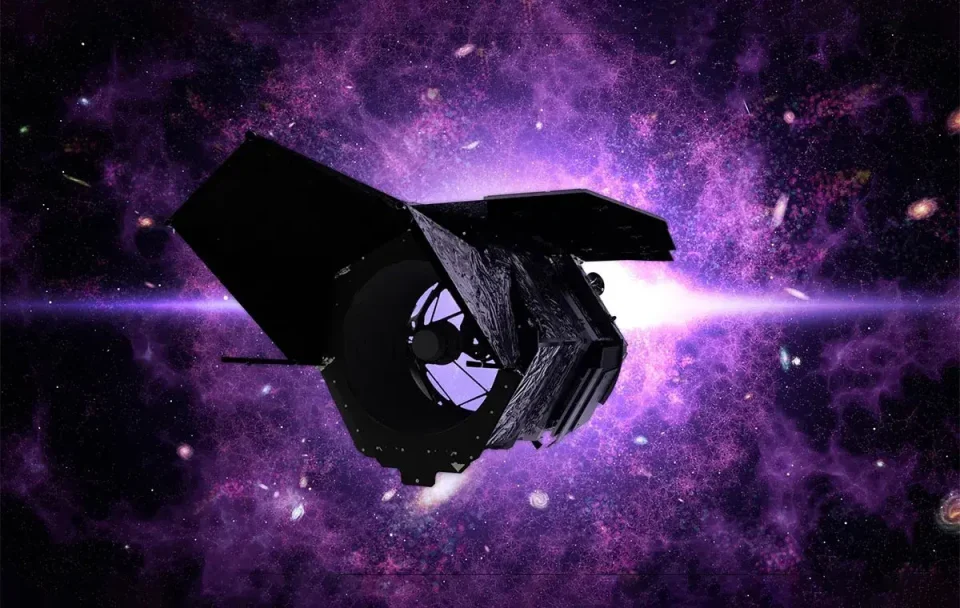
Shafaqna English- NASA’s Nancy Grace Roman Space Telescope is scheduled to launch on August 30, 2026, carrying advanced instruments designed to survey vast regions of the universe and directly image distant exoplanets. A precision optical system developed by Germany’s Max Planck Institute for Astronomy will enable its coronagraph to observe planets far fainter than their host stars.
The Roman Space Telescope will travel to the Sun–Earth L2 Lagrange point, about 1.5 million kilometers from Earth. Its 2.4-meter primary mirror is the same diameter as Hubble’s, while its Wide Field Instrument will provide a detector area roughly 100 times larger than Hubble’s.
Over its planned five-year survey, Roman is expected to detect around 100,000 exoplanets through the transit method and an additional 1,000 through gravitational microlensing. These techniques identify planets indirectly by observing their effects on starlight.
Its Coronagraph Instrument (CGI), however, is designed to take the next step: directly imaging previously discovered exoplanets. By blocking the intense light of a host star, the coronagraph can reveal much fainter planets orbiting nearby. Roman will specifically target cooler and smaller worlds, including Jupiter-like planets that primarily reflect starlight.
The challenge is extreme. The planets Roman aims to image can be about one billion times fainter than their host stars. To achieve the necessary precision, the Max Planck Institute for Astronomy developed Precision Alignment Mechanisms (PAMs) that control the position of the coronagraph’s masks, filters and mirrors with extraordinary accuracy.
The PAM system was tested extensively on Earth, including a service-life model that completed more than 27,000 movements—roughly twice the stress expected for a flight model. Six flight models will be permanently installed aboard Roman.
The CGI will also employ adaptive optics to correct distortions within the telescope’s optical system in real time. If its initial space tests are successful, the instrument could become available to astronomers for exoplanet research.
Researchers describe CGI as a major technological milestone toward eventually imaging Earth-like rocky planets around other stars. Such observations would require even more powerful telescopes, including concepts such as NASA’s proposed Habitable Worlds Observatory, envisioned with a primary mirror of at least six meters.
Source: Astrobiology