

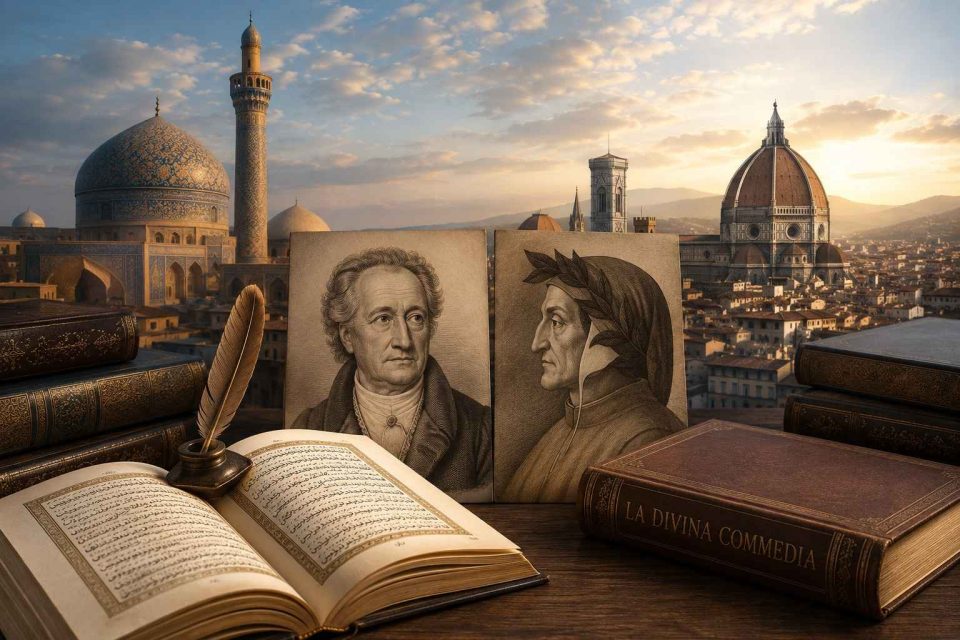
Shafaqna English– Beyond its vast contributions to other disciplines, Islamic culture has exerted a profound influence and played a formative role in European literature and linguistics.
According to Shafaqna, nations that have engaged with Islamic culture and scholarship over the centuries have not only been uniquely enriched by the teachings of Islam and the Muslim world, but have also derived the foundational elements and essence of their contemporary intellectual landscape from the expansive Islamic tradition. This influence is by no means limited to philosophy, mathematics, science, or technology; rather, it permeates the domains of poetry, art, narrative writing, commentaries, grammar, literary criticism, stylistics, and rhetoric.
The profound literary impact of Islam upon Europe is perhaps best articulated by Professor Hamilton Alexander Rosskeen Gibb, author of the literary section of The Legacy of Islam, wherein he examines the influence of Arabic and Islamic literature on European traditions. He notes:
“It must be recognized that the East—that is to say, the Islamic world—paved a new path for Europeans, enabling them to attain their present standing in literature”.
Dante and Goethe were among Europe’s most renowned poets and writers, both of whom portrayed Islam and its beliefs in their works with remarkable depth and eloquence.
Goethe and West–Eastern Divan
Johann Wolfgang von Goethe was a German writer and polymath, and is considered to be at the pinnacle of the German Enlightenment. As a writer, Goethe is in many ways the Shakespeare of Germany — yet Goethe’s influence and work goes beyond literature and into the world of philosophy, culture, science, religion, and many other areas of learning.
Through his life, Goethe harbored a deep fascination for Islam and its rich literary and philosophical traditions. His engagement with Islam was not merely superficial. Goethe’s work displays a profound love and respect for Islam, and this is reflected in his literary works, personal writings, and conversations. At twenty-three, Goethe composed a marvelous ode in praise of Muhammad (peace be upon Him), and at seventy he confessed frankly that he was contemplating “celebrating in awe that holy night, when the Qur’an, in its entirety, was presented to the Prophet from on high.” Goethe once stated, amazingly, that he does not “reject the suspicion that he himself is a Muslim.”
Goethe’s interest in Islam was partly inspired by his broad intellectual curiosity and his quest for universal truths. He was drawn to the spiritual and moral dimensions of Islam, as well as to its rich poetic and mystical aspects. His admiration for the Prophet Muhammad (PBUH) and the Holy Quran is evident in various pieces of his work, but most notably in his collection of poems, West-östlicher Divan (West-Eastern Divan), which he wrote between 1814 and 1819.
This collection, influenced by the Persian poet Hafez, is a celebration of cultural exchange and dialogue between the East and the West. Goethe wrote:
“He who knows himself and others will recognize: Orient and Occident can no longer be separated”.
This line encapsulates his belief in the inseparability of Eastern and Western cultures, exemplifying his vision of a unified human experience beyond cultural and religious boundaries — which is a perspective not uncommon in European Enlightenment thinkers.
Goethe and Prophet Muhammad (PBUH)
Goethe’s admiration for the Prophet Muhammad (PBUH) is another significant aspect of his engagement with Islam. He expressed this reverence in his poem “Mahomets Gesang” (The Song of Muhammad), which portrays the Prophet (PBUH) as a dynamic and transformative force of nature.
In this poem, Goethe describes Muhammad (PBUH) as a powerful stream that starts as a small spring and grows into a mighty river, symbolizing the Prophet’s (PBUH) spiritual journey and the expansive impact of his message on the world.
Goethe and the Holy Quran
Goethe’s personal correspondence and reflections reveal his profound respect for the Quran. In his conversations with Johann Peter Eckermann, Goethe praised the Quran’s moral teachings and poetic beauty. Goethe remarked:
“It is a book of revelation to a people at all times and in all places.”
This statement underscores his view of the Quran as a timeless and universal source of wisdom.
Indeed, aside from the Bible, Goethe was familiar with the Quran more than any other religious text. He read the Quran several times and even wrote some surahs in Arabic. He collected various review essays under the name “Koran-Auszüge” (“Summary of the Quran”). This text, which appears to have studied at least two-thirds of the Quran, is currently in the Goethe Museum in Düsseldorf.
Dante and The Divine Comedy
Dante Alighieri was an Italian poet, prose writer, literary theorist, moral philosopher, and political thinker. He is best known for the monumental epic poem La commedia, later named La divina commedia (The Divine Comedy), that is widely considered one of the most important poems of the Middle Ages and the greatest literary work in the Italian language.
Dante’s Divine Comedy stands as one of the most profound and intricate eschatological visions in Western literature. The epic poem recounts the poet’s journey through the three realms of the afterlife—Inferno (Hell), Purgatorio (Purgatory), and Paradiso (Paradise)—guided by the Roman poet Virgil and his beloved Beatrice. While deeply rooted in Christian theology, the Divine Comedy notably exhibits striking parallels with Islamic eschatological traditions, particularly the Mi’raj.
The relation of Dante’s Divine Comedy to Arabic-Islamic literary tradition has been a contested topic for the last two centuries. Miguel Asin Palacois, a Spanish scholar and a Catholic priest in his work La Eschatologia Musulmana en La Divina Comedia in 1919 proved to some extent that Dante borrowed the central idea of his Commedia from Islamic tradition of Al-Isra and Al-Miraj.
Palacois draws parallel between early Islamic philosophy and the Divine Comedy and argues that Dante derived many features and episodes about the hereafter directly or indirectly from the spiritual writings of Ibn-Arabi, Al-Ma’arri and of course from the Isra and Miraj.
Palacois noticed relevant similarities at a symbolic and formal level as Divine Comedy describes Dante’s journey in the realms of afterlife and represents allegorically the soul’s journey towards God and Isra or Miraj describe the night journey of Prophet Muhammad (pbuh) both physically and spiritually during a single night around the year 621.
Source: Tahoor, Researchgate, Wikipedia, Medium