

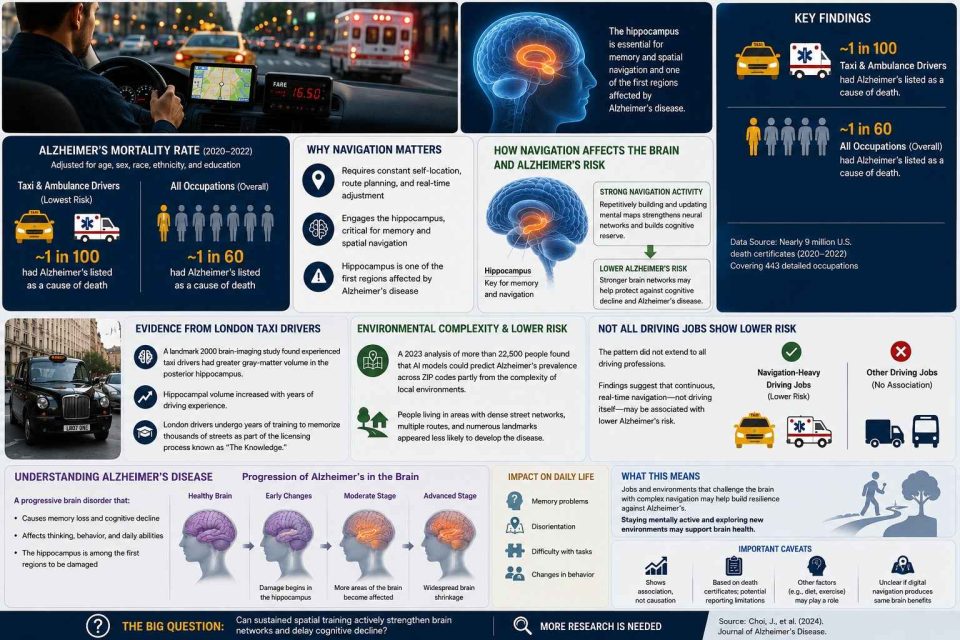
Shafaqna English- Taxi and ambulance drivers had the lowest Alzheimer’s mortality rate among 443 occupations in a large U.S. study, raising new questions about whether jobs that require constant spatial navigation could help protect the brain against cognitive decline, according to PsyPost.
The 2024 study analyzed nearly 9 million U.S. death certificates from 2020 to 2022. After accounting for age, sex, race, ethnicity and education, about 1 in 100 taxi and ambulance drivers had Alzheimer’s listed as a cause of death, compared with roughly 1 in 60 people across all occupations.
Researchers found that the pattern did not extend to all driving professions. The findings suggest that continuous, real-time navigation—not driving itself—may be associated with the lower risk. Taxi and ambulance drivers must constantly locate themselves, identify destinations and adjust their routes as conditions change.
Scientists have linked this type of activity to the hippocampus, a brain region central to memory and spatial navigation and one of the earliest areas affected by Alzheimer’s disease. Problems with navigation and orientation can also appear among the early symptoms of the condition.
Earlier research on London taxi drivers provides supporting evidence. A landmark 2000 brain-imaging study found that experienced taxi drivers had greater gray-matter volume in the posterior hippocampus, with volume increasing alongside years of driving experience. London drivers undergo years of training to memorize thousands of streets as part of the licensing process known as “The Knowledge.”
Other research has also associated spatially complex environments with lower Alzheimer’s risk. A 2023 analysis of more than 22,500 people found that machine-learning models could predict Alzheimer’s prevalence across ZIP codes partly from the complexity of local environments. People living in areas with dense street networks, multiple routes and numerous landmarks appeared less likely to develop the disease.
Researchers have suggested that repeatedly building and updating mental maps may strengthen neural systems involved in spatial navigation, potentially contributing to greater cognitive reserve.
However, it remains unclear whether performing spatial reasoning through digital maps, such as geographic information systems used by engineers, planners and geospatial analysts, produces the same neurological effects as navigating physical environments.
The evidence so far shows an association rather than proof that navigation-intensive work prevents Alzheimer’s. Further research will be needed to determine whether sustained spatial training can actively strengthen brain networks and delay cognitive decline.
Source: PsyPost