

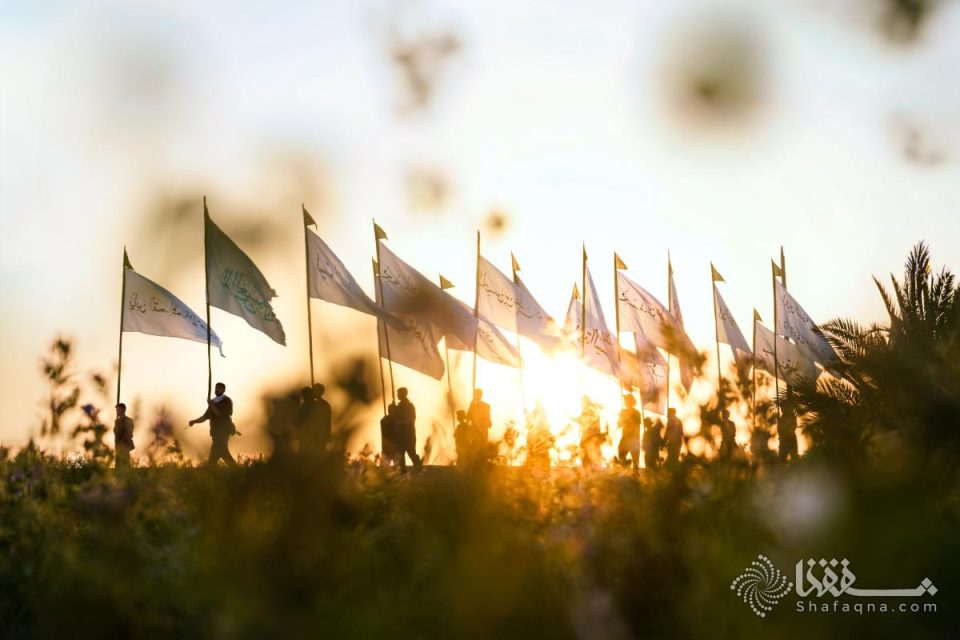
Shafaqna English– The Bi-quarterly Journal of “Religion, Management & Governance” has published the paper “Ethnography of Arbaeen March as a Model of Human Dignity” written by Mohammad Asaadi, Hossein Amadeh and Khalil Noruzi in 2023.
According to Shafaqna, this paper analyzes and describes Arbaeen culture and decision-making strategies to promote it.
The Arbaeen March is one of the Shia rituals held in the days leading up to 20 Safar (Arbaeen), and it is carried out from various parts of Iraq to Karbala to observe Arbaeen. This event is considered to be the largest annual religious gathering in the world.
Functions of the Arbaeen March, the culture of Arbaeen on foot from Najaf to Karbala and back to the country of origin, strategies for making optimal decisions, and the findings are mentioned below:
- The spirit of martyrdom and resistance against the oppressors, which is the message of Ashura culture, is the most important soft transnational power of Shia and Islam. Among these, the events based on the Ashura uprising of Imam Hussain (AS), including the Arbaeen March, play the main role in explaining and promoting the Ashura culture and the spirit of martyrdom.
- Arbaeen is rooted in love for the province and family of the Prophet of Islam (PBUH) as the greatest social and national capital of the Islamic system, and having a great divine and popular network of Arbaeen is a special feature of the Islamic system. The extraordinary role of the Arbaeen March in preserving and promoting the religious foundation of the people of the world is obvious. That is why the importance of Arbaeen’s walk plays a key role in increasing the soft power of the Islamic system.
- In the religion of Islam, pilgrimage on foot is considered a good tradition and in this regard, many recommendations have been provided by the infallible Imams (AS). Imam Sadiq (AS) considered the pilgrimage to his house on foot as the most popular means of closeness to the Lord and said: One pilgrimage on foot is equal to seventy pilgrimages.
- The Iraqi people are honorary servants of Imam Hussain (AS) and the findings reveal that in the period of Arbaeen 2013 to 2019, the behavior of the Arbaeen servants has not changed. The servants are still serving with great creed. They receive the pilgrims of Imam Hussain (AS) with open arms and from the bottom of their souls.
- The people of neighboring countries are in the path of imitating the Iraqi people. The findings show that the behavior of the Arbaeen pilgrims (especially non-Iraqi pilgrims) is greatly improving and positively changing. Pilgrims have become more believable over the past few years and like to become servants and serve other pilgrims instead of being consumers on the Najaf-Karbala route.
- Observations of dignity in the Arbaeen route include feeding the pilgrims, presence of various jobs, presence of different nationalities such as Iranians, caravans from Lebanon, Turkey, and a few people from Africa and Europe, presence of different cultures and different ages from children to older men and women, and accommodation for pilgrims.
- Some of the Mawkibs have been established for years, some of the processions were built as buildings and some were being completed, some of the settlements were temporary, and some of the trailers were parked to accommodate the pilgrims along the way.
- Arbaeen creates a very high level of convergence between diverse cultures and strengthens and expands the great global culture of Shiism.
Source: rmg.isu.ac.ir
- Read more from Shafaqna: 20 phenomenological facts about Arbaeen foot pilgrimage