

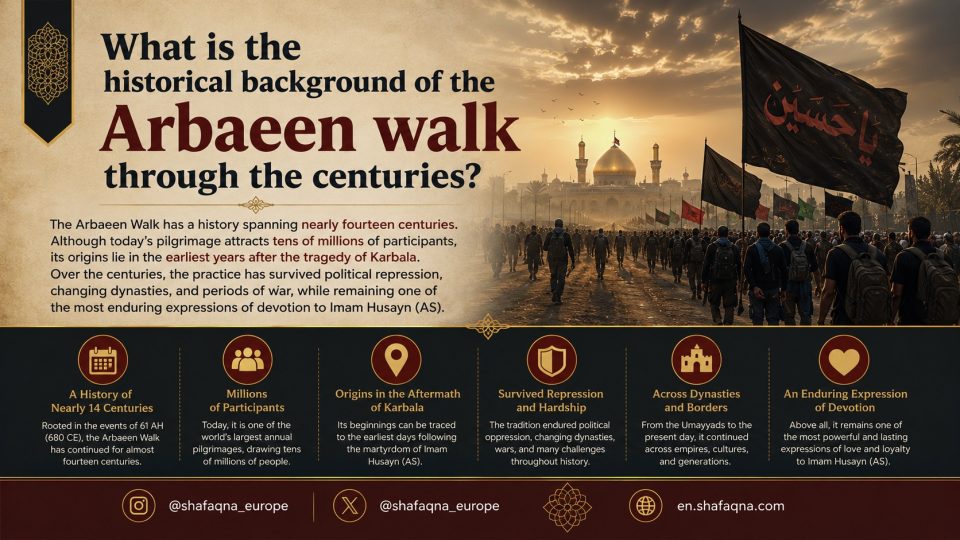
Shafaqna English | AI & HI adopted content- What is the historical background of the Arbaeen walk through the centuries?
The Arbaeen Walk has a history spanning nearly fourteen centuries. Although today’s pilgrimage attracts tens of millions of participants, its origins lie in the earliest years after the tragedy of Karbala. Over the centuries, the practice has survived political repression, changing dynasties, and periods of war, while remaining one of the most enduring expressions of devotion to Imam Husayn (AS).
1. Origins (680 CE / 61 AH)
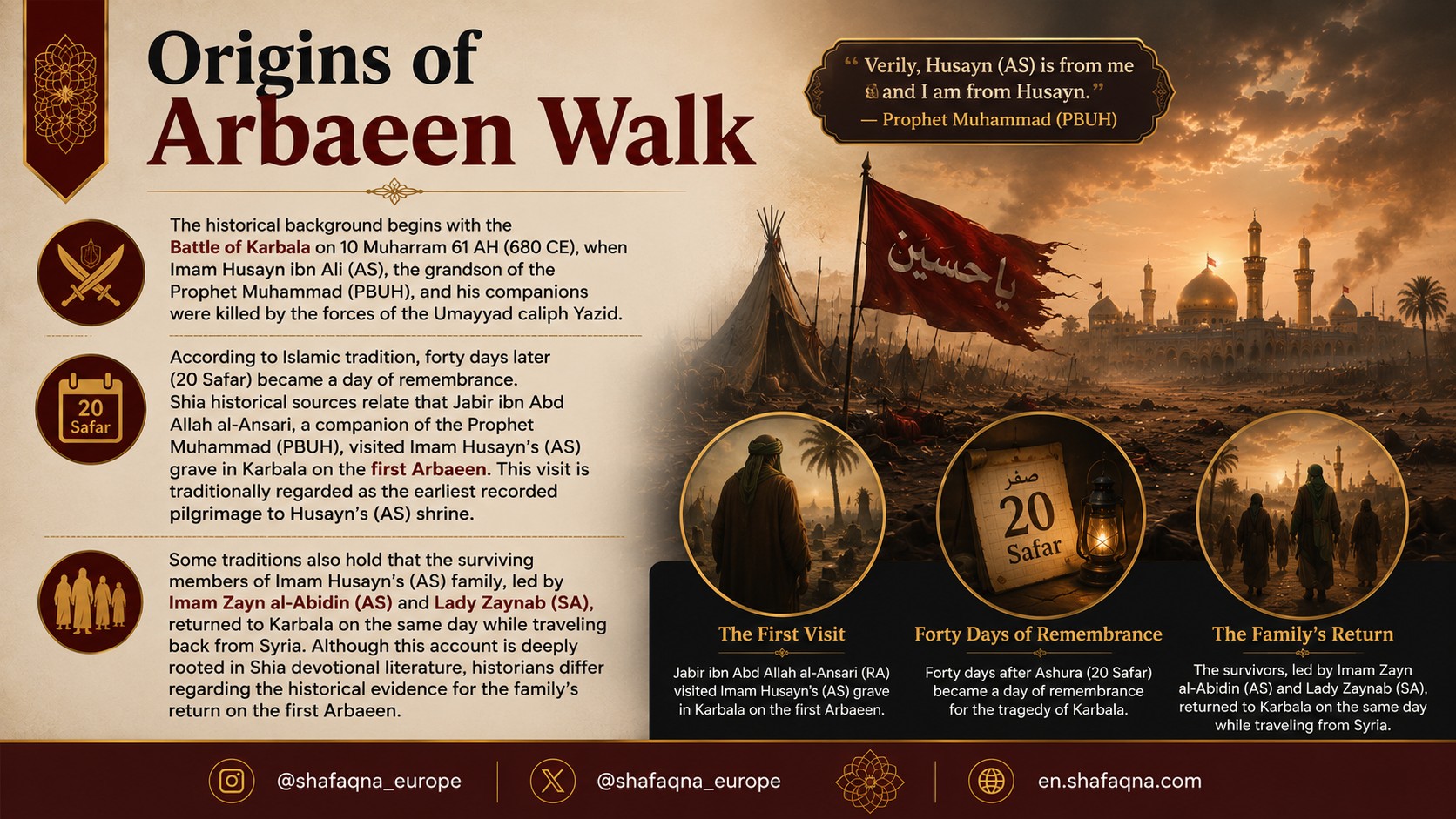
The historical background begins with the Battle of Karbala on 10 Muharram 61 AH (680 CE), when Imam Husayn ibn Ali (AS), the grandson of the Prophet Muhammad (PBUH), and his companions were killed by the forces of the Umayyad caliph Yazid.
According to Islamic tradition, forty days later (20 Safar) became a day of remembrance. Shia historical sources relate that Jabir ibn Abd Allah al-Ansari, a companion of the Prophet Muhammad (PBUH), visited Imam Husayn’s (AS) grave in Karbala on the first Arbaeen. This visit is traditionally regarded as the earliest recorded pilgrimage to Husayn’s (AS) shrine.
Some traditions also hold that the surviving members of Imam Husayn’s (AS) family, led by Imam Zayn al-Abidin (AS) and Lady Zaynab (SA), returned to Karbala on the same day while traveling back from Syria. Although this account is deeply rooted in Shia devotional literature, historians differ regarding the historical evidence for the family’s return on the first Arbaeen.
2. Early Islamic Centuries
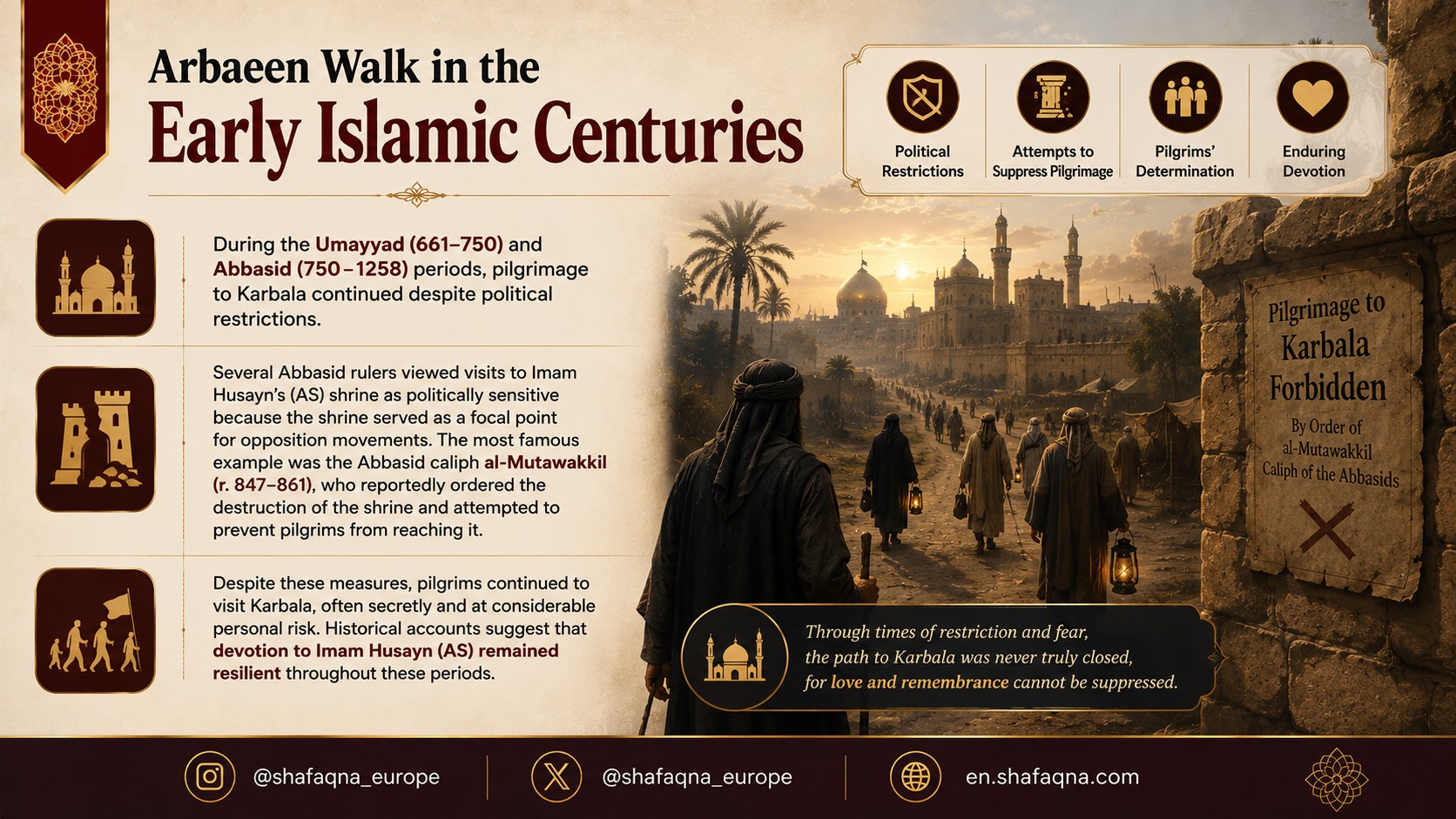
During the Umayyad (661–750) and Abbasid (750–1258) periods, pilgrimage to Karbala continued despite political restrictions.
Several Abbasid rulers viewed visits to Imam Husayn’s (AS) shrine as politically sensitive because the shrine served as a focal point for opposition movements. The most famous example was the Abbasid caliph al-Mutawakkil (r. 847–861), who reportedly ordered the destruction of the shrine and attempted to prevent pilgrims from reaching it.
Despite these measures, pilgrims continued to visit Karbala, often secretly and at considerable personal risk. Historical accounts suggest that devotion to Imam Husayn (AS) remained resilient throughout these periods.
3. Medieval Period
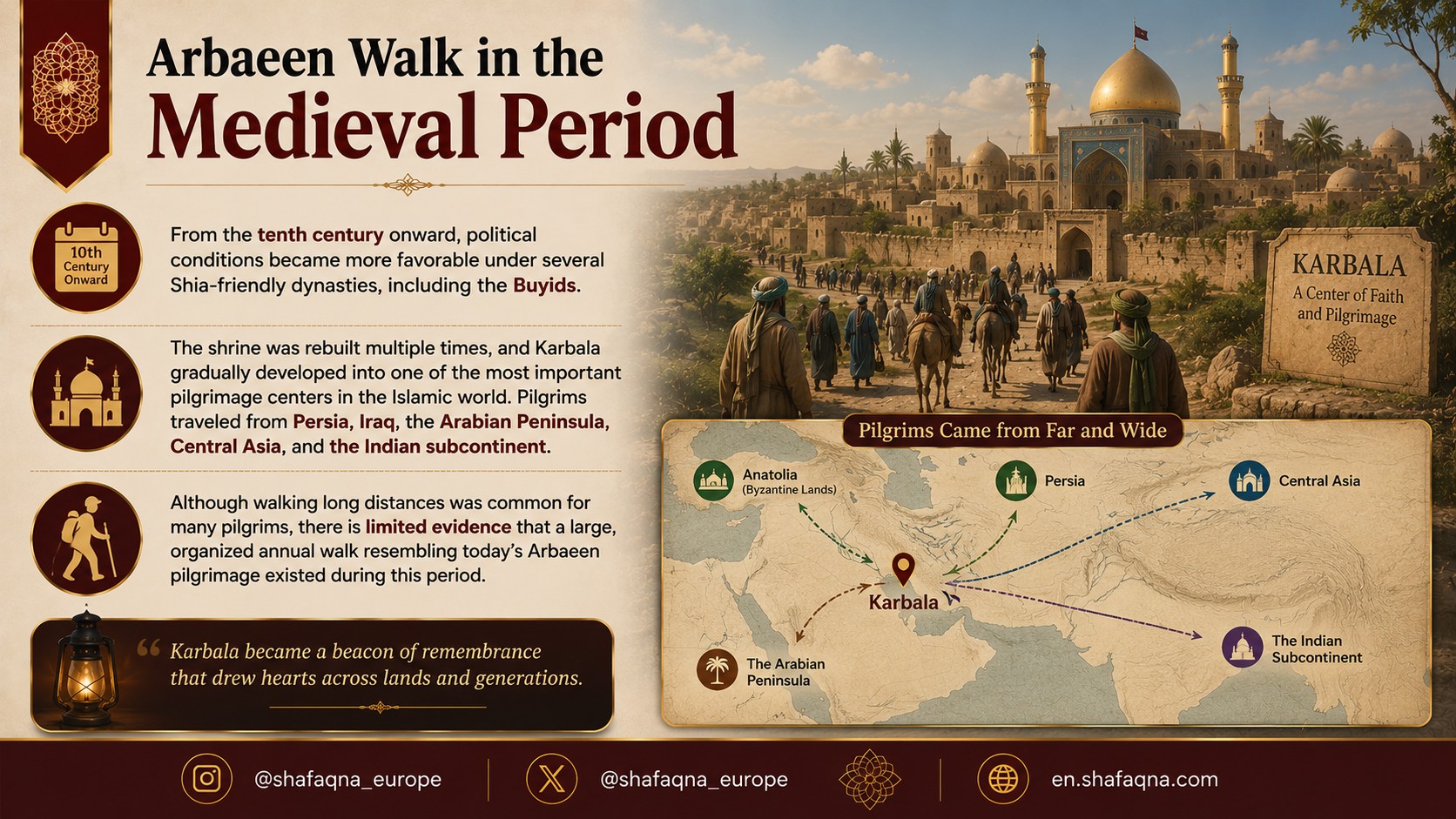
From the tenth century onward, political conditions became more favorable under several Shia-friendly dynasties, including the Buyids.
The shrine was rebuilt multiple times, and Karbala gradually developed into one of the most important pilgrimage centers in the Islamic world. Pilgrims traveled from Persia, Iraq, the Arabian Peninsula, Central Asia, and the Indian subcontinent.
Although walking long distances was common for many pilgrims, there is limited evidence that a large, organized annual walk resembling today’s Arbaeen pilgrimage existed during this period.
4. Ottoman and Safavid Eras
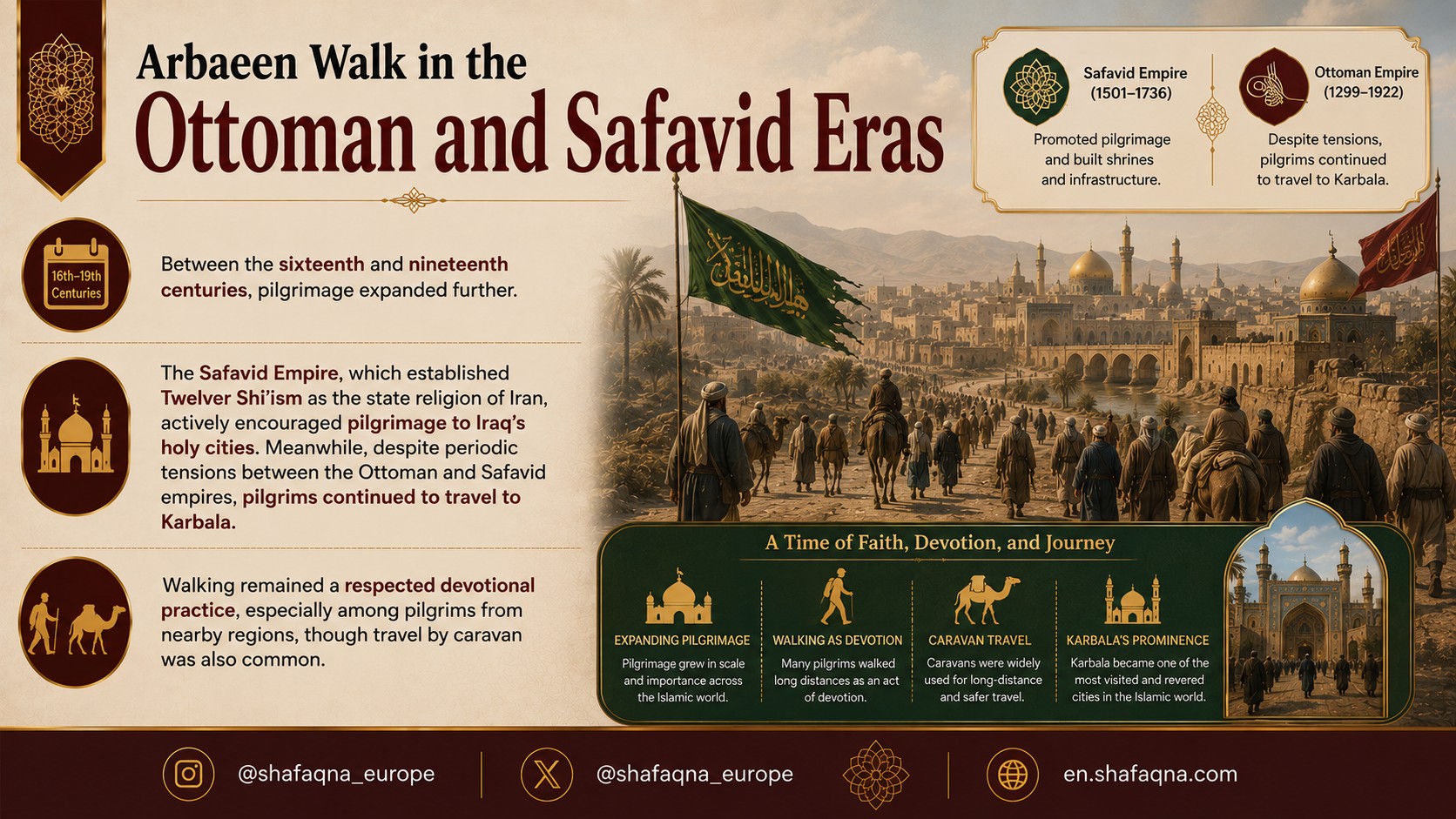
Between the sixteenth and nineteenth centuries, pilgrimage expanded further.
The Safavid Empire, which established Twelver Shi’ism as the state religion of Iran, actively encouraged pilgrimage to Iraq’s holy cities. Meanwhile, despite periodic tensions between the Ottoman and Safavid empires, pilgrims continued to travel to Karbala.
Walking remained a respected devotional practice, especially among pilgrims from nearby regions, though travel by caravan was also common.
5. Twentieth Century
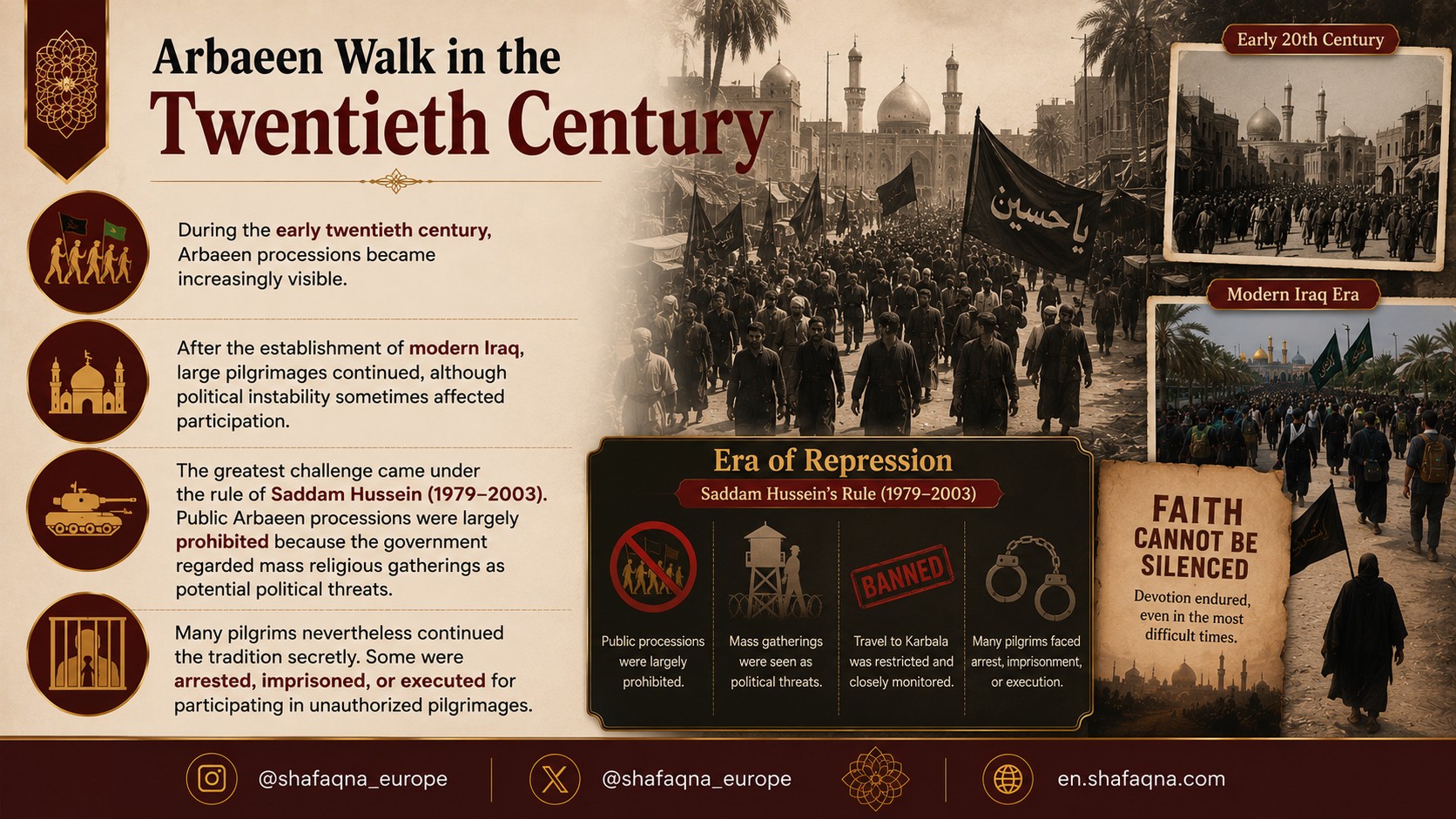
During the early twentieth century, Arbaeen processions became increasingly visible.
After the establishment of modern Iraq, large pilgrimages continued, although political instability sometimes affected participation.
The greatest challenge came under the rule of Saddam Hussein (1979–2003). Public Arbaeen processions were largely prohibited because the government regarded mass religious gatherings as potential political threats.
Many pilgrims nevertheless continued the tradition secretly. Some were arrested, imprisoned, or executed for participating in unauthorized pilgrimages.
6. Revival After 2003
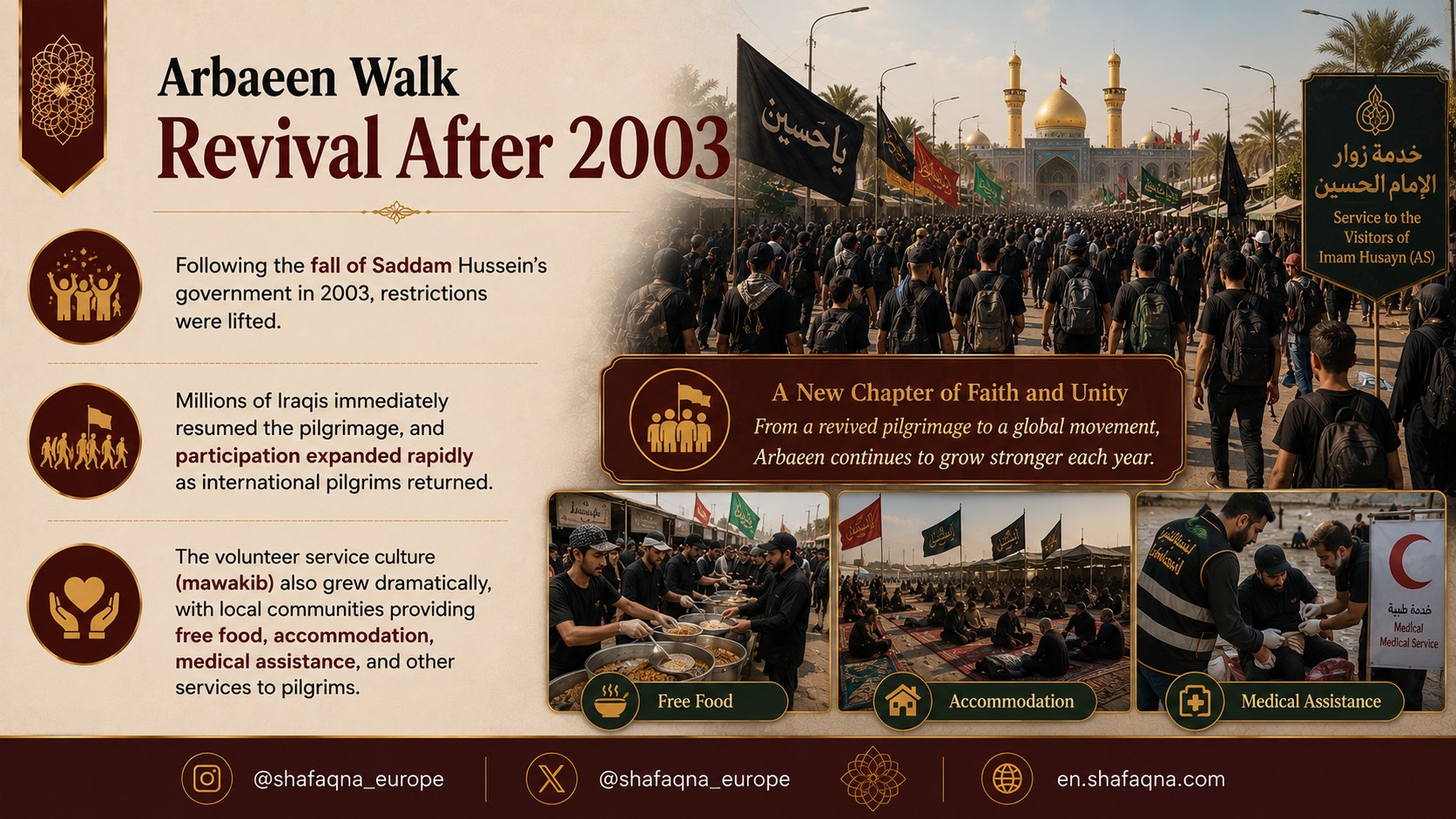
Following the fall of Saddam Hussein’s government in 2003, restrictions were lifted.
Millions of Iraqis immediately resumed the pilgrimage, and participation expanded rapidly as international pilgrims returned.
The volunteer service culture (mawakib) also grew dramatically, with local communities providing free food, accommodation, medical assistance, and other services to pilgrims.
7. The Contemporary Arbaeen Walk
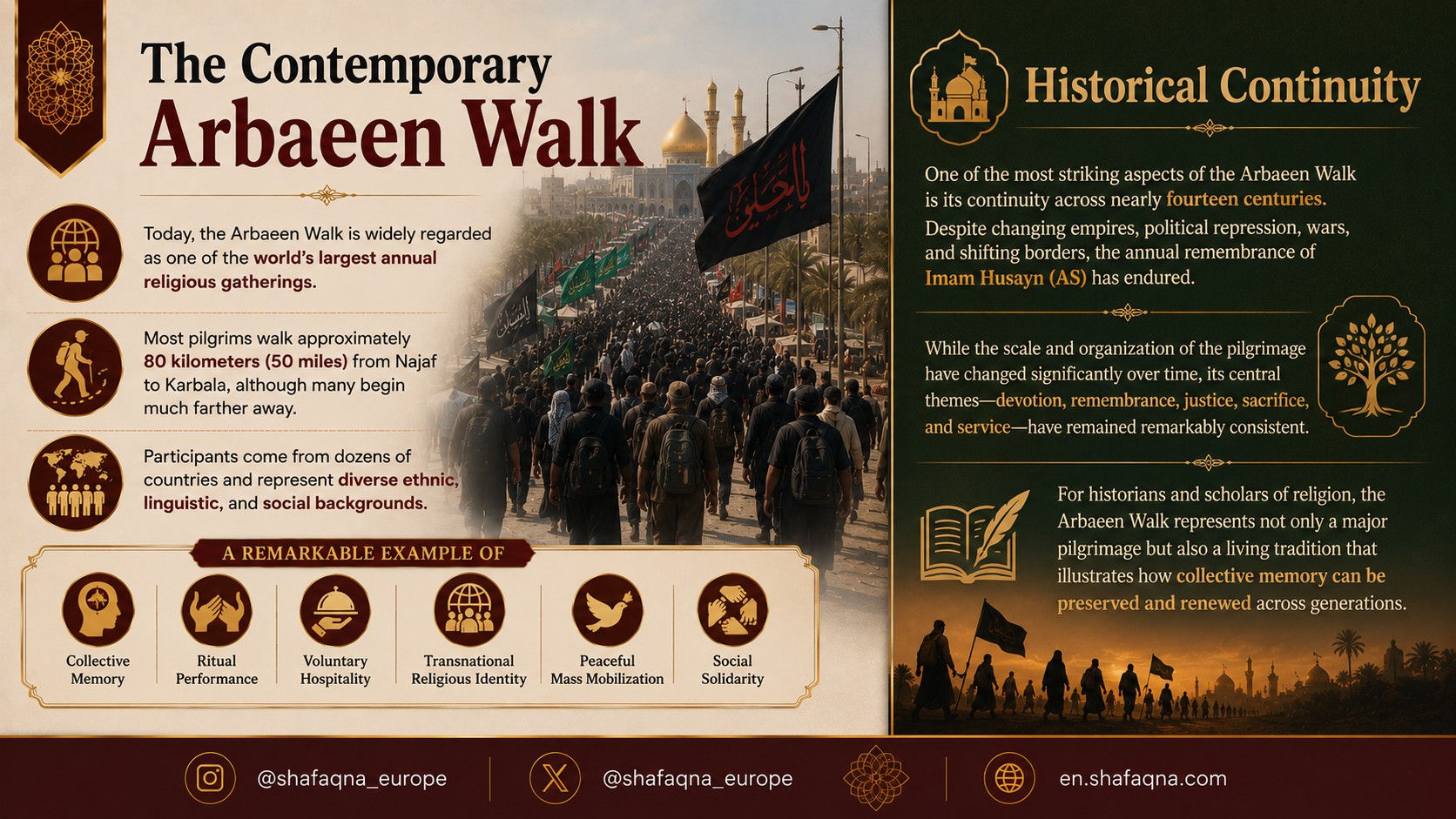
Today, the Arbaeen Walk is widely regarded as one of the world’s largest annual religious gatherings.
Most pilgrims walk approximately 80 kilometers (50 miles) from Najaf to Karbala, although many begin much farther away. Participants come from dozens of countries and represent diverse ethnic, linguistic, and social backgrounds.
Beyond its religious significance, scholars have examined the pilgrimage as a remarkable example of:
- collective memory
- ritual performance
- voluntary hospitality
- transnational religious identity
- peaceful mass mobilization
- social solidarity
Historical Continuity
One of the most striking aspects of the Arbaeen Walk is its continuity across nearly fourteen centuries. Despite changing empires, political repression, wars, and shifting borders, the annual remembrance of Imam Husayn (AS) has endured. While the scale and organization of the pilgrimage have changed significantly over time, its central themes—devotion, remembrance, justice, sacrifice, and service—have remained remarkably consistent.
For historians and scholars of religion, the Arbaeen Walk represents not only a major pilgrimage but also a living tradition that illustrates how collective memory can be preserved and renewed across generations.
Graphs are generated by ChatGPT Image Creator.
Shafaqna English’s AI & HI adoption: Methods and motivations