

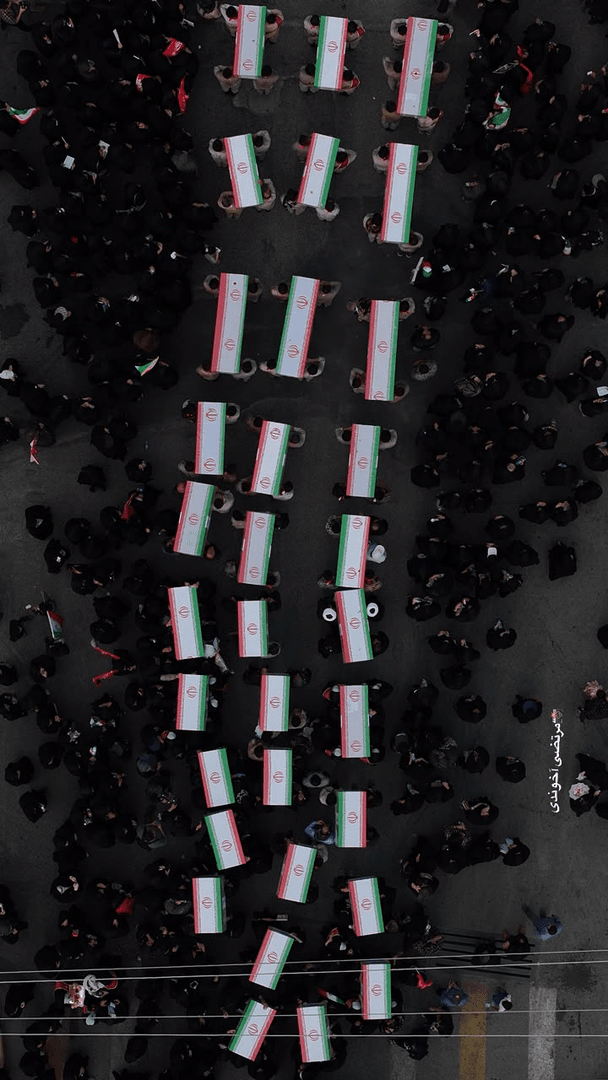
Shafaqna English- Minab in southern Iran has held a funeral ceremony for 34 victims of the Shajareh Tayyebeh School massacre, whose remains were identified after nearly five months of recovery efforts and DNA testing.
According to Shafaqna, the victims’ remains were carried through Minab in a ceremony attended by bereaved families and local officials on Wednesday.
Nearly five months after the devastating attack that claimed 168 lives—the majority of them young schoolchildren- people gathered to pay their final respects to the victims of the tragic February 28 US missile strike on the Shajareh Tayyebeh Elementary School.
They assembled to bury newly identified remains, even as international scrutiny mounts over Washington’s refusal to provide a transparent accounting of the tragedy.
Makan remains the only victim whose remains have not been recovered
Ataollah Navaki, director general of the Foundation of Martyrs and Veterans Affairs in Hormozgan Province, said that 68 pieces of remains belonging to the 34 victims were recovered from the rubble of the school over nearly five months of search operations.
The recovered remains were sent to specialized genetic laboratories for identification, he said. After the victims were conclusively identified and with the consent of their families, the remains were prepared to be reunited with the bodies that had previously been buried, he added.
Makan, a first-grader, remains the only victim whose remains have not been recovered. Mojtaba Qahramani, head of Hormozgan’s judiciary, told Fars news agency that specialized search operations at the school site revealed no trace of the child, as the direct impact occurred precisely where he was standing. An empty grave has been prepared for Makan, while his personal belongings—including a bloodstained sweater and a single sneaker—are preserved in a glass display case at a nearby mosque.
People would never forget deliberate killing of innocent children
The ceremony was more than a funeral; it was a reaffirmation of the collective memory of a people who would never forget the “deliberate killing” of innocent children at the school, Hormozgan Deputy Governor for Political, Security and Social Affairs Ahmad Nafisi said.
“The people of Minab have turned out in large numbers, delivering a resounding response to the enemies who thought the passage of time would make this tragedy fade from memory,” he said,
34 mothers lay their children’s remains to rest again
The recovery and identification process required careful navigation of Islamic traditions to ensure the victims were laid to rest with full dignity.
Ata Navaki, Director General of the Hormozgan Foundation of Martyrs and Veterans Affairs, stated that following consultations with members of the provincial Security Council and the families of the victims, it was decided—with the families’ explicit consent—that some of the newly recovered remains would be reunited with the victims’ bodies.
In the Minab case, authorities explained that graves were reopened after the remains of over two dozen students, missing since the February 28 attack, were recovered and identified. The exhumation was carried out strictly to allow these newly recovered remains to be buried alongside their classmates already interred in the same grave. According to Islamic jurisprudence, this action falls within recognized exceptions because its sole purpose is to complete the burial and ensure all identified remains receive a proper and dignified burial in accordance with sacred traditions.
Shajareh Tayyebeh Elementary School has drawn broad international condemnation
The US attack on Shajareh Tayyebeh Elementary School has drawn broad international condemnation. The United Nations Human Rights Office emphasized the right of victims’ families to know the truth.
“The families of the little girls who were killed are entitled to the truth of how this happened,” Ravina Shamdasani, a UN Human Rights Office spokesperson, said.
CNN, Sky News, and other media have underscored the severity of the strike, detailing the devastating human toll and highlighting growing questions surrounding the US military’s targeting decisions.
US has refused to complete a standard intelligence review
Nearly five Months after the strike, the Pentagon has refused to complete a standard intelligence review to establish exactly what happened, according to multiple US officials and media reports. While military assessments completed within days of the attack confirmed US forces struck the school, the final intelligence review—standard procedure for incidents involving mass civilian casualties—was never ordered.
Reports indicate senior US military commanders bypassed explicit database warnings that intelligence on Iranian targets was severely outdated, choosing “expediency” over caution as they rushed target lists at the outset of the war.
US President Donald Trump suggested the findings might never be made public, claiming “nobody is ever going to be able to say what happened there” and speculating that the imagery could be “AI-generated”.
The school is set to be registered as a national site in Iran, recognizing its significance as a symbol of sacrifice and resilience.