

Shafaqna English- Muharram is the first month of the Islamic calendar and marks the beginning of the Islamic New Year. It is one of the sacred months (al-Ashhur al-Hurum), during which warfare was forbidden both in the era of Ignorance (Jahiliyyah) and in the light of Islam.
For the Shia, however, this month holds a profound and exalted sanctity; for it was on the tenth day of this month that Hussain ibn Ali (AS), the third Shia Imam, was martyred. In solemn remembrance of his supreme sacrifice, Shia Muslims devote the first ten days of this month to mourning, observing rituals of elegy recitation, chest-beating, and the performance of Ta’ziyah (passion plays) to keep his sacred memory alive.
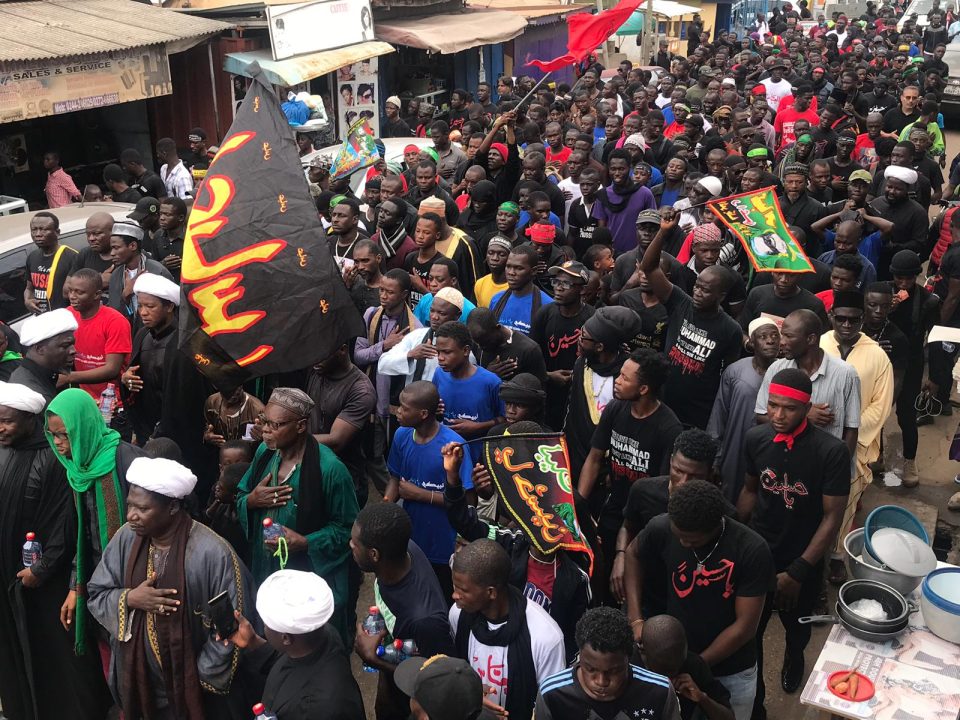
The observance of the days of Muharram, along with the holding of mourning ceremonies and commemorations for Abu Abdullah al-Hussain (AS), has a long historical tradition in African countries. With the arrival of Tasu’a and Ashura, in many countries across the African continent, Shia Muslims hold special gatherings to mourn Imam Hussain (AS) and his sons.
Algeria, Egypt, Morocco, and Tunisia are among the North African countries where Shias, in step with Shia Muslims in other parts of the world, grieve for that exalted Imam and hold mourning assemblies. In some parts of East Africa as well, Shia Muslims commemorate these days through chest-beating mourning rituals, religious lectures, feeding the poor, dressing places in black, and suspending work and business on the ninth and tenth of Muharram, as well as on the twentieth of Safar (Arbaeen).
We shall now proceed to explore the diverse traditions and observances practiced across various African nations to commemorate the month of Muharram, with a particular focus on the solemnity of the Day of Ashura.
Muharram and Ashura in East Africa
Honoring Muharram in East Africa, the islands of Zanzibar, Mombasa, and the Comoros Archipelago — with the beginning of each new Islamic lunar year — Shia Muslims commence a series of rituals and observances.
In East Africa, Shias mark the month of Muharram by draping their homes, mosques, and public spaces in black, and by hosting religious gatherings, inviting renowned Islamic scholars and eminent preachers to deliver sermons at the principal mosques. The mourning ceremonies in this region include rawḍakhwani (elegy recitation) and chest-beating (sinah-zani); the closure of businesses on Tasu’a, Ashura, and Arbaeen; the recitation of Ziyarat Ashura in Ḥosseiniyas and mosques; the setup of symbolic exhibitions depicting the scene of Karbala and the historic events of early Islam; the performance of ta’ziyah (passion plays); processions in Dar es Salaam and Zanzibar; and the feeding of mourners and the needy, a practice known locally as “Niazi” (offering of votive food).
Of course, the customs of commemorating Muharram and Ashura vary from city to city and from country to country, and the native Shias — whose indigenous cultures have become intertwined with the teachings of Shiism — keep the memory of these sacred days alive through their own distinct rituals.
Muharram in Algeria
In Algeria, where Shias form a small minority, they gather around graves on Ashura to hold their ceremonies. They regard pilgrimage to Karbala (Ziyarat Karbala) as being akin to pilgrimage to the House of God (Hajj). Many Algerians on the day of Ashura visit holy sites and shrines — such as the tombs of Sidi al-Hawari and Sidi al-Hasani in the city of Oran — where they supplicate and seek intercession. On Mount Mangas in the city of Setif, there is a site believed to bear the footprint of Imam Ali (peace be upon him), where Shias gather on Ashura.
Remarkably, after the name Muhammad, the names Ali, Hasan, and Hussain among men, and Fatimah al-Zahra among women, are among the most common names in Algeria.
Muharram in Tanzania
In Tanzania, Zanzibar, and countries such as Madagascar and Comoros, there are individuals who, during Muharram, recite elegies and rawḍah in the Persian language. In Zanzibar, traditional chest-beating and elegy-recitation ceremonies are held every year during Muharram and Arbaeen. One of these mourning rites is known as “Bushehri chest-beating” in which mourners chant verses such as:
“Ali Asghar, the light of Zaynab’s eyes…”
In this ceremony, participants form a circle, lock arms around one another’s necks, and rotate in unison. Native Shias have learned this style of chest-beating and attribute it to the Iranians.
During Muharram, the Khoja Shias hold a well-known ceremony called “Ruz-e Hossein” (The Day of Hossein) at the central Shia mosque in Dar es Salaam (the largest city, industrial center, and principal port of Tanzania). Representatives of various Islamic schools, Sunnis, and native Shias attend this gathering and deliver speeches in Swahili and local languages to introduce and promote the school of Shiism.
Every year during Muharram and Safar, the main streets and centers of the capital Dar es Salaam, as well as the central Shia mosque, are draped in black. From the first night of Muharram, the Indian Khoja Shias set up models (maquettes) of the Karbala event, maintain a day-by-day timeline of the first ten days of Muharram, and broadcast rawḍah recitations and dirges from their thoroughfares, mosques, and affiliated spaces to honor these sacred days.
The fervent participation in daily congregational prayers, nightly mourning vigils, and lectures by renowned preachers during the nights of Muharram — especially on the nights of Tasu’a and Ashura — are among the most solemn and magnificent Shia observances in Dar es Salaam. As Ashura approaches, the Shia Muslims residing in Dar es Salaam, joined by native Tanzanians, hold a night procession on the eve of Ashura, moving from the old Shia Mosque toward the central Shia Mosque, beating their chests and reciting elegies along the way. In the midst of this mourning procession, some Hindus and non-Shias also join and offer their votive gifts.
Source: Shiafrica, Parstoday