

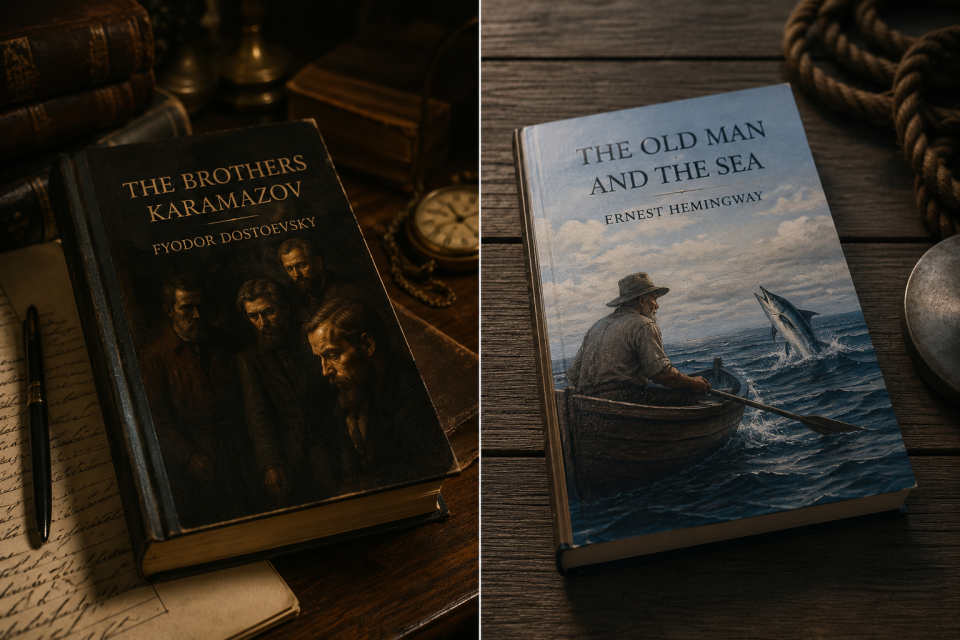
Shafaqna English- Religious symbolism has consistently been one of the richest and most influential elements in literary creations. These symbols, rooted in human beliefs, myths, and spiritual experiences, lend profound depth to literary works, offering the audience complex layers of meaning. Through these symbols, authors can express abstract concepts such as faith, sin, redemption, suffering, and the search for the meaning of life tangibly and understandably.
According to Shafaqna, among these, two novels, Fyodor Dostoevsky’s The Brothers Karamazov and Ernest Hemingway’s The Old Man and the Sea, stand out as masterpieces of world literature, exemplifying the use of religious symbols to explore the depths of the human soul and psyche. Dostoevsky’s novel, by posing fundamental theological and ethical questions, and Hemingway’s novel, with its simple yet profound depiction of man’s struggle against nature and the quest for inner peace, both weave intricate threads of deep human concepts through the lens of religious symbolism.
The Old Man and the Sea by Ernest Hemingway
World literature is full of stories that go far beyond simple narration, taking readers on a journey into the depths of the human soul and mind. One of the brightest of these works is The Old Man and the Sea, the immortal masterpiece of Ernest Hemingway; a story that, beneath its apparent simplicity, contains a world of meaning, philosophy, psychology, and religious symbolism. This book tells the story of an endless struggle between human beings and nature, hope and despair, victory and defeat—a struggle in which Santiago, a lonely yet indomitable old man, is not only at war with the sea, but also with himself, with fate, and with the fundamental realities of life.
Yet The Old Man and the Sea is not merely a tale about fishing. This short but profound novel opens a window into the innermost layers of the human psyche, where fear, hope, endurance, and the meaning of life are deeply intertwined. From the perspective of psychology, Freudian and Jungian psychoanalysis, existentialist philosophy, symbolism, and even sociology, this work is a rich source of compelling interpretations that can lead us toward a deeper understanding of the human spirit and its eternal struggle with existence.
Every element in the work reflects humanity’s struggle with destiny, the hardships of life, and the meaning of effort and failure. Many critics have compared the old man to Christ (AS), as one who has endured great suffering in pursuit of his goals. In fact, according to critics, Santiago, like Christ (AS), is a fighting human being standing against the hardships of life, nature, and time—one who does not merely struggle with the sea and the marlin, but also with old age, physical weakness, and an unkind fate. Like Jesus (AS), he is a man who, despite setbacks, continues to fight, and this struggle is captured in one of the novel’s most famous lines:
“A man can be destroyed, but not defeated.”
Of course, the religious symbols in The Old Man and the Sea are not limited to comparing Santiago with Christ (AS); other elements in the story are also presented as symbols. For example, Marlin symbolizes a noble goal and perfection, and has been likened to the lofty aims of Christ (AS), which initially seemed far out of reach, but were made attainable through the prophet’s patience and effort.
The “sea” in the novel portrays the challenges of life—sometimes calm, sometimes stormy—but patience and perseverance, like the path of Christ’s (AS) life, make it possible to overcome them. The “sharks” in The Old Man and the Sea symbolize destructive forces that render the old man’s efforts fruitless. These sharks have been interpreted as the enemies of Christ (AS), who repeatedly stood in his way and hindered his progress toward his lofty goals.
Santiago’s wounded hands are another reference to Christianity and sacred suffering. Throughout the story, the old man’s hands are severely wounded, especially during his struggle with the marlin; this scene recalls the crucifixion of Christ and his suffering. The wounded hands function as a symbol of sacrifice: Santiago, like Christ (AS), endures pain and cannot escape it.
The Brothers Karamazov by Fyodor Dostoevsky
The Brothers Karamazov, the famous and classic work of Fyodor Dostoevsky, is one of the masterpieces of world literature and has remained the subject of scholarly, critical, and serious readerly attention for more than a century. This novel is not merely a dramatic family story; it also explores profound philosophical, religious, moral, and psychological meanings, and some have compared it—especially in terms of its theological and psychological depth—to Rumi’s Masnavi.
In terms of content, the novel unfolds within the setting of a deeply troubled family: a tyrannical father and his sons, each of whom represents a different human and philosophical dimension. Ivan pretends to be rationalist and skeptical of God and morality; Alyosha is spiritual and devoted to the Christian faith; Dmitri is passionate and caught in moral and emotional conflict; and Smerdyakov, the illegitimate son, symbolizes social issues.
One of the most striking aspects of the novel is its exploration of fundamental questions about the existence of God, the meaning of life, and free will. Ivan Karamazov, through his formulation of the “rational man” and his denial of God, exposes a deep rift between truth and faith. He symbolizes absolute rationalism and philosophical skepticism, and throughout the novel he grapples with fundamental challenges to faith and morality. Ivan is a complex character who, because of the inner conflict between his desire for justice and his rejection of traditional religious concepts, is often caught in profound spiritual turmoil.
His famous dialogue with his brother Alyosha on the existence of God and the problem of evil, especially in the section known as “The Grand Inquisitor,” is among the most remarkable philosophical passages in world literature. By rejecting traditional faith, Ivan sees free will as a heavy burden that leaves human beings alone before the evil and pain of the world. He argues that divine justice, if it exists, must answer for the suffering of the innocent, and for this reason he finds faith in a just God difficult to accept.
Ivan’s worldview symbolizes the moral and philosophical crises of modern humanity. Throughout the story, he struggles with the effects of this skepticism and eventually descends into a mental crisis, which reflects the sufferings and contradictions of his thought. Through this character, Dostoevsky portrays the struggle between reason and faith, intellect and doubt, and the power of the mind versus the heart.
Alyosha, on the other hand, the younger brother and a bearer of Christian faith, symbolizes hope, unconditional love, and spiritual surrender. He is a disciple of a spiritual elder, and through his humane and compassionate treatment of others, he becomes a renewing force throughout the novel. Alyosha expresses his faith through the direct experience of love and forgiveness.
He functions not only as Ivan’s opposite, but also, in a sense, as an embodiment of divine will among human beings. In many scenes, Alyosha, through his compassion and deep understanding, reduces division and hatred, seeking instead to create reconciliation and solidarity among the characters.
Alyosha also shows that true faith means living in service to others and accepting suffering. His beliefs contain deep traces of Russian Orthodox Christianity, and from this perspective, his character symbolizes a revival of spirituality in the modern world.
The combination of these two figures creates the tension at the heart of The Brothers Karamazov: the conflict between reason and faith. As Dostoevsky himself is said to have expressed it:
“If Christ is on one side and truth on the other, I would stand with Christ.”
Source: Bornaandishan, Asriran, Fararu